Home › West Slope
Older structures on hillside lots require assessment before the machine arrives — finding suspect materials during demolition stops the project where early assessment would not.
Demolition on a West Slope property is not simply a matter of scheduling a machine and knocking a structure down. Beaverton Excavation Co. approaches teardown on this hillside differently than it approaches a flat suburban lot, and the age of the housing stock here is the primary reason. Structures built before modern construction practice routinely contain materials — insulation, floor tile, pipe insulation, roofing compound, lead-based paint — that require professional assessment and, in many cases, licensed abatement before a demolition permit will issue. Finding those materials during demolition rather than before it is the scenario that stops a project cold.
West Slope sits on the western slope of the Portland west hills, 1.62 square miles of hillside residential land east of Cedar Hills and northwest of Raleigh Hills. The slope itself creates the second set of constraints. A flat urban lot can be accessed from multiple angles, and debris haul vehicles can usually stage close to the structure. On a hillside lot where access is a single driveway cut into the slope, the sequence of machine positioning, reach, debris staging, and truck turnaround is planned before the first cut is made — because once demolition begins, reorganizing around a mistake costs time and money that neither the owner nor the crew wants to spend.
Each step in a West Slope demolition project exists because cutting a corner at that step creates a problem that is harder to fix later than it would have been to handle in sequence. The order matters more on a sloped, constrained site than on level ground with full drive-around access.
Each of these steps has a reason that is mechanical rather than procedural. None of them exists because a checklist requires it. Working through them in sequence on a West Slope hillside lot is what separates a demolition project that closes cleanly from one that generates neighbor complaints, erosion violations, or a void that requires emergency repair during the first wet season. The excavation contractors in Beaverton, OR who work regularly on older hillside properties understand why the sequence matters and plan around it from the start.
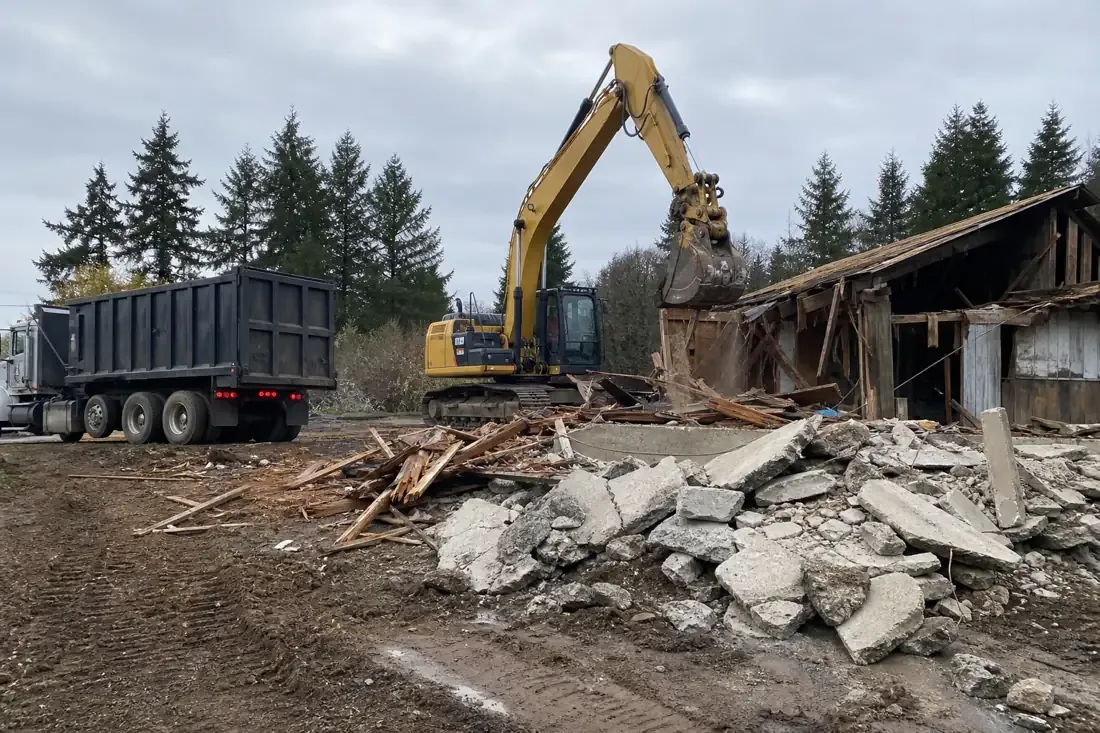
On a flat lot, debris from a demolished structure can be staged anywhere on the property and a haul vehicle can circle to load from multiple sides. On a West Slope lot where the driveway is cut into a hillside and the property drops away from the street, debris has to come out through one corridor. That means the excavator works the structure from a position that keeps the pile moving toward the exit point rather than away from it, haul vehicles are staged and sequenced so the driveway is never blocked by a truck that cannot yet leave, and the largest debris items — concrete foundations, masonry — are broken to a size the haul vehicles can accept before they reach the pile. An unplanned demolition on a constrained hillside lot generates exactly the kind of situation where the machine has nowhere to put the next piece because the exit is already full.
The downhill neighbor on a West Slope lot did not contract for the demolition project next door, and the project cannot deliver debris, sediment, or structural material onto their property. During active demolition, the debris fall zone is controlled by the machine operator working the structure from a position that drops material onto the property being demolished rather than over its boundaries. Temporary barriers at the downhill property line catch anything that escapes the controlled zone. After mechanical demolition is complete, the disturbed slope surface is managed for erosion through the first wet season before the owner or a subsequent contractor begins the next phase of work. Our Beaverton excavation team confirms downhill protection is in place before demolition begins, not after a problem arrives.
A demolition permit in Washington County requires utility disconnection confirmation and, for structures of sufficient age, a hazardous materials assessment report. The report documents what was found, what was abated, and by whom. An abatement contractor working under a licensed contractor designation must complete regulated material removal before the demolition permit is typically issued, and the abatement itself requires its own permit and air-monitoring protocol. For West Slope structures built before 1980, the combination of the assessment lead time, the abatement scheduling, the abatement completion documentation, and the demolition permit review means the pre-demolition sequence alone takes several weeks. Property owners who assume the permit can be pulled the week before the machine arrives understand quickly why that schedule does not work.
Tualatin Valley Fire & Rescue serves West Slope, and TVFR requires confirmation that gas is off and the line has been purged before any open burning or torch work near the demolition site. Clean Water Services erosion-control review applies to the disturbed hillside area after clearing. Oregon DEQ’s 1200-C stormwater permit applies if the total disturbed area — including the area cleared, graded, and backfilled — reaches one acre. On most West Slope residential lots that threshold is not reached, but on larger parcels or combined lots it can be. The Beaverton excavation crew walks through the permit sequence with each owner at the start of planning so there are no surprises about timeline or cost as the project moves from assessment to abatement to demolition to site restoration.
Demolition on a sloped older lot is a sequenced process, not a single task; work with excavation contractors in Beaverton, OR who plan the access and abatement before mobilizing.
For most structures built before 1980, a hazardous materials assessment is required before the demolition permit will issue. The assessment identifies asbestos-containing materials, lead-based paint, and other regulated substances. If any are found, a licensed abatement contractor removes them under a separate permit before mechanical demolition begins. Discovering those materials during demolition rather than before it stops the project until abatement is complete, which is significantly more disruptive and costly than scheduling it in the correct order.
Access is constrained to whatever approach the lot geometry allows, which on most hillside properties means a single driveway cut into the slope. The excavator’s working position, reach angle, and debris staging area are all planned around that constraint before work begins. The machine works the structure from a position that moves debris toward the exit rather than toward a blocked corner, and haul vehicles are sequenced so the corridor stays clear. On a flat lot those logistics are forgiving. On a hillside lot they have to be right before the machine moves.
The debris fall zone is controlled by the machine operator working from a position that drops material onto the subject property rather than across its boundaries. Temporary barriers at the downhill property line catch anything the controlled fall zone does not contain. After clearing, the disturbed hillside surface is protected with appropriate erosion controls before the next wet season arrives so that sediment does not travel downslope to neighboring lots or drainage channels.
The void left after a foundation is removed is backfilled with compacted structural fill placed in tested lifts rather than left open. On a hillside lot, an open void concentrates water at a low point on the slope and can create the conditions for a small slip. The backfill is compacted and graded to restore the hillside profile before the site is released. That work is included in the demolition scope rather than treated as a separate project for a later contractor to handle.
The cost depends on structure size, debris volume, site access constraints, hazardous material findings, and what the haul-off plan requires given the slope and driveway geometry. On a hillside lot where access is limited, haul vehicles may need to make more passes to clear the same debris volume than they would on a flat lot with drive-around access. The abatement scope — which varies based on what the assessment finds — is priced separately by the abatement contractor and is not included in the demolition estimate.
For a structure of typical age in West Slope, the sequence runs from the hazardous materials assessment through abatement completion through demolition permit issuance. The assessment itself takes a week or more to schedule and report. If regulated materials are found, abatement scheduling, work, and documentation add additional weeks. The demolition permit review in Washington County adds its own processing time. Property owners who plan the start of demolition work should count on at least four to six weeks from assessment initiation to machine mobilization, sometimes more depending on what the assessment finds.
Send over the basics of the job and we will visit the property, walk the ground with you, and price the scope in writing — no pressure and no obligation. Call, text, or use the form; we reply the same business day.
Call or text to reach our team directly. During business hours we pick up when we can, and every message gets a return call.
(458) 272-9359Hours: Mon–Sat, 7am–6pm