Home › Beaverton
Clean Water Services compliance and DEQ 1200-C stormwater controls planned before grading begins, not added after.
Erosion control in Beaverton is not a line item added to a project after the grading crew finishes. Beaverton Excavation Co. designs and installs erosion and sediment control measures before any blade touches the ground, because under Clean Water Services jurisdiction in Washington County, controls that are absent or non-functional when an inspector arrives do not produce a fine and a warning — they produce a stop-work order that halts all ground-disturbing activity until every deficiency is corrected and the site is re-inspected. The delay, not the paperwork, is what damages a construction schedule.
Beaverton sits in a warm-summer Mediterranean climate where the wet season runs from October through May — seven months of rain landing on disturbed soil with no plant cover to hold it. The Tualatin Valley’s silty clay is inherently erodible once it is graded and left bare, and the high winter water table means runoff moves across the surface rather than infiltrating. Every construction site that disturbs ground during this window is generating sediment-laden runoff that Clean Water Services has jurisdiction to regulate, regardless of whether the site has crossed the one-acre threshold that triggers Oregon DEQ 1200-C permit coverage.
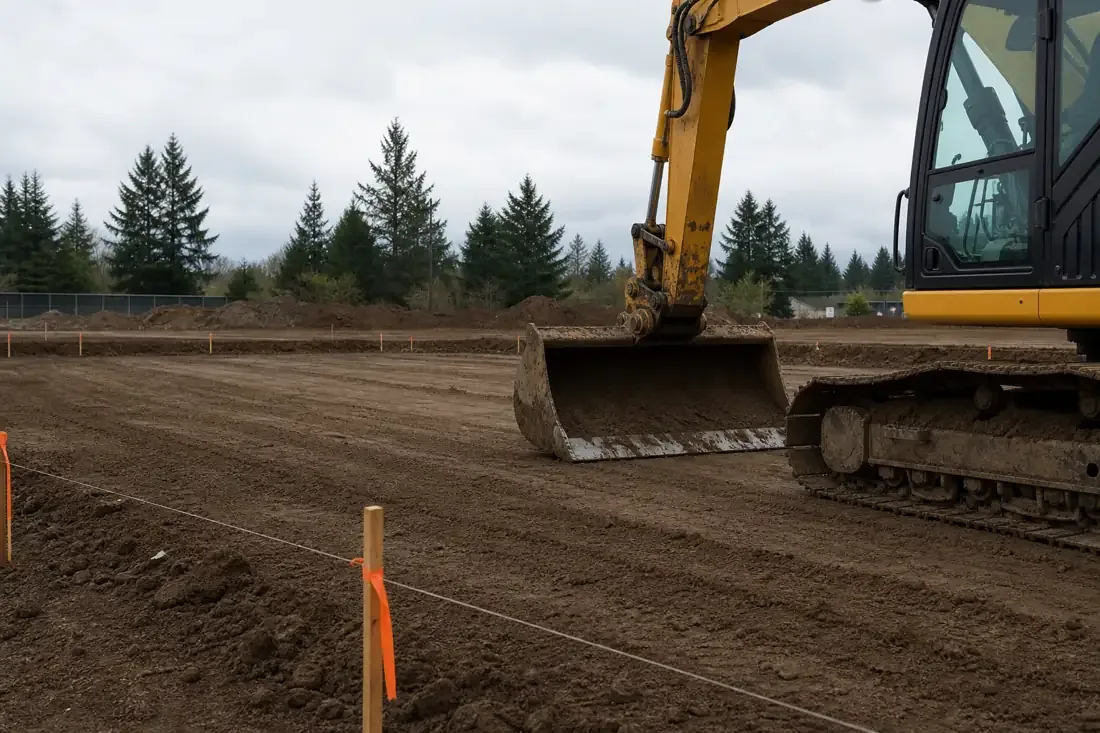
Erosion and sediment control is a system of physical measures, each addressing a specific part of how water picks up and transports soil from a disturbed site. No single control does the whole job, and removing one element from the system compromises the elements around it.
These controls function as a system. A perimeter silt fence without a functioning rock entrance allows sediment to leave the site on truck tires every trip to the street. Understanding how each element interacts with the others is why excavation contractors in Beaverton, OR design the control plan before the first grading pass, not while equipment is already operating on bare ground.
Clean Water Services regulates construction-site stormwater in Washington County under their Erosion Prevention and Sediment Control standards. Any project with ground disturbance on a site that drains to the Clean Water Services service area is subject to those standards, regardless of project size. The Oregon DEQ 1200-C general stormwater permit adds a separate threshold: sites disturbing one acre or more must obtain permit coverage before grading begins, file a Stormwater Pollution Prevention Plan, and maintain documented inspection records throughout active construction. Projects under one acre still face Clean Water Services requirements and local permit conditions, so the one-acre line primarily changes the state-level paperwork burden rather than eliminating the physical controls required at any scale of disturbance.
An inspector who arrives at a site without functioning controls does not write a citation and schedule a follow-up visit. The inspector issues a stop-work order halting all ground-disturbing activity immediately. The site cannot resume until controls are installed, functioning, and cleared by a return inspection — which is scheduled on the inspector’s calendar, not the contractor’s. On any project with a concrete pour, a framing crew, or a utility inspection already booked, that stop cascades into sub-contractor rescheduling that costs far more in lost time and rebooking fees than any corrective installation would have. The controls cost a fraction of what a stopped schedule costs, which is why integrated planning for erosion control is how Beaverton excavation projects are structured from the start rather than addressed reactively.
An erosion control plan that looks correct on a dry inspection day can fail entirely on the first significant storm of the wet season. Silt fence that is staked but not buried in a continuous key trench at the base gets undercut by concentrated flow and bypassed within hours. Inlet protection sized for typical flow is overwhelmed by a heavy October storm and allows sediment to enter the pipe system in exactly the volume the control was supposed to prevent. Wattles staked without overlapping at seams allow sheet flow to route around the gap and reach the perimeter unimpeded. None of these failures are visible on a dry walkthrough because they require real flow velocity to manifest. Designing controls that hold under seven months of Pacific Northwest winter rain means positioning them where water actually concentrates on the graded site, not where installation is convenient for the crew.
The reason controls are designed and installed before grading begins rather than added at the end is that grading creates the drainage patterns the controls have to address. Once the site is disturbed and re-graded, the flow paths and low points are defined by the new contours. Controls planned before that point can be positioned at the actual concentrated-flow corridors and downslope perimeter locations. Controls added after grading because an inspection is approaching get placed where it is fastest to install them rather than where the water goes. That reactive approach produces controls that look installed but do not intercept the flow paths they were designed to stop. The Beaverton excavation crew sequences erosion and sediment control installation before grading begins, which is also the point when installation is least disruptive to the active work on site.
Erosion and sediment control planned into the project from the start keeps the schedule moving — connect with excavation contractors in Beaverton, OR who know what an inspector actually looks for.
Clean Water Services is the Washington County special service district responsible for managing stormwater and surface water quality in the Tualatin River watershed. Any construction site within the district that disturbs ground and generates sediment-laden runoff falls under their Erosion Prevention and Sediment Control standards. This applies regardless of project size. The district has authority to issue stop-work orders on non-compliant sites, which halts construction until corrective measures are installed and cleared by re-inspection.
The Oregon Department of Environmental Quality 1200-C general permit applies when a construction project will disturb one acre or more of ground. Coverage must be obtained before grading begins. The permit requires a Stormwater Pollution Prevention Plan documenting all planned erosion and sediment controls, responsible parties, and inspection procedures. Projects under one acre are not subject to the state permit but still face Clean Water Services requirements and local permit conditions that require physical controls.
A typical project requires perimeter silt fence installed with a continuous trench-and-bury base, a rock construction entrance at every vehicle access to the public road, inlet protection on any storm drain catch basins within or adjacent to the disturbed area, and straw wattles on graded slopes. Projects with seeded slopes that will not be immediately paved or covered also need erosion control matting to protect seed until vegetation establishes. Specific requirements depend on site drainage, slope, and proximity to waterways.
The inspector issues a stop-work order halting all ground-disturbing activity immediately. The site stays stopped until every identified deficiency is corrected and a return inspection clears the site to resume. The return inspection is scheduled on the inspector’s calendar, not the contractor’s. If the stop occurs before a scheduled concrete pour, framing delivery, or utility inspection, those sub-contractors must be rebooked and the project schedule absorbs the delay at full cost.
The cost depends on the perimeter length requiring silt fence, the number of inlets needing protection, slope length requiring wattles, and the number of vehicle access points needing rock entrances. On a typical residential grading project, the controls are a small fraction of the total project budget. The comparison that matters is controls versus a stop-work order: a single re-inspection delay cascades into sub-contractor rescheduling costs that far exceed what the controls would have cost if installed correctly from the start.
Yes. Controls must remain in place and functional until the site is stabilized by vegetation or covered by impermeable surfaces such as pavement or concrete. A graded site without plant cover is just as erodible in October as it was on the day of grading. Controls are typically removed during final cleanup after vegetation has established or final surfaces are in place and the site is no longer generating sediment-laden runoff. Removing controls early to speed up cleanup is a common source of violations on otherwise compliant projects.
Send over the basics of the job and we will visit the property, walk the ground with you, and price the scope in writing — no pressure and no obligation. Call, text, or use the form; we reply the same business day.
Call or text to reach our team directly. During business hours we pick up when we can, and every message gets a return call.
(458) 272-9359Hours: Mon–Sat, 7am–6pm