Serving Beaverton & all of Washington County, OR Free estimates: (458) 272-9359
Beaverton Excavation Co.

Home › Raleigh Hills

Excavation Contractor in Raleigh Hills, OR

Hillside lots in Raleigh Hills require a different approach than flat suburban ground — slope changes the water, the volumes, and the equipment plan.

Licensed & insured in Oregon Free on-site estimates Local Washington County crew Wet-season ready

Raleigh Hills sits in the southwest hills of Washington County at the intersection of Oregon Routes 10 and 210, where Beaverton lies to the west, West Slope to the north, and Progress and Garden Home to the south. The ground here is not the valley floor that most excavation guides assume. Beaverton Excavation Co. works this terrain regularly, and the first thing any property owner should understand is that slope changes nearly every calculation: water moves rather than pools, cut volumes are larger than they appear from the surface, and retaining structures become part of the project design from the start rather than an afterthought discovered when grading is already underway. The community has a population of 6,196, and most of those residents live on ground that tilts in ways that matter for excavation.

The practical implication of that tilt is this: on a flat lot, the excavation questions center on depth, soil type, and where to place the spoils. On a sloped lot in Raleigh Hills, the questions multiply. Where does runoff go during the wet season, and how fast? What does the cut volume actually look like once the grade is accounted for? Can the cut material be reused as fill, or does it need to leave the site? Will a retaining wall be required, and if so, how tall? The Tualatin Valley silty clay that underlies much of this area behaves differently depending on whether it sits on a grade or lies flat, and any contractor who does not account for that difference in the estimate is not accounting for a significant portion of the real work.

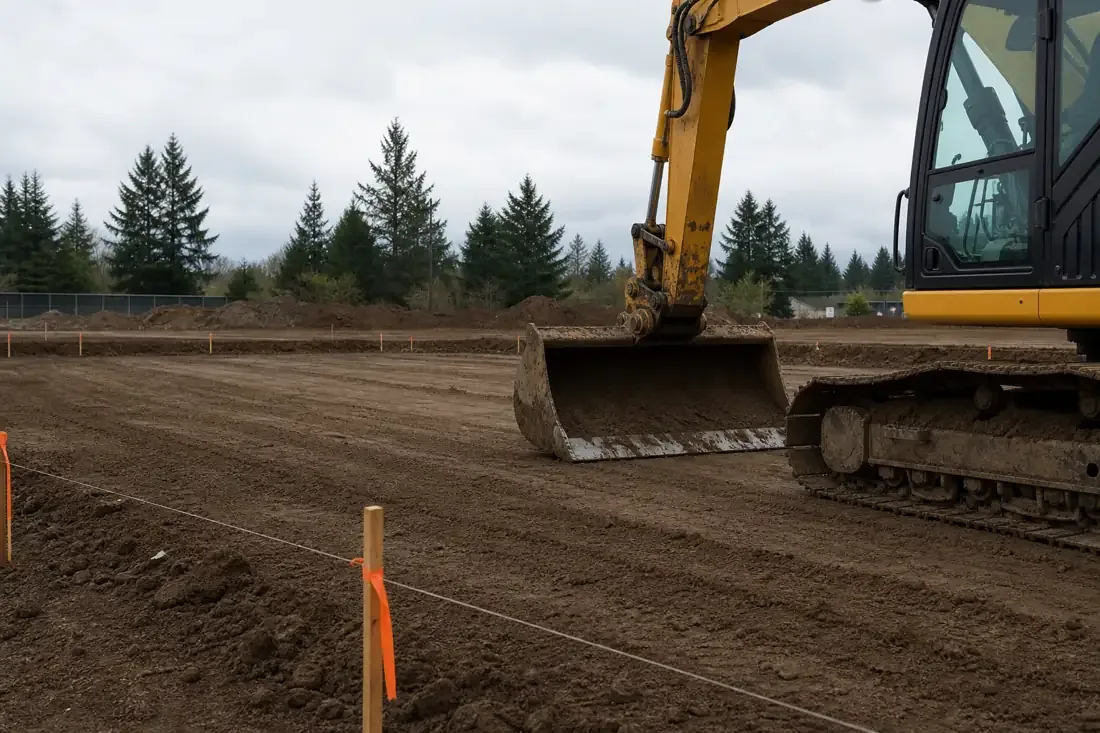
Grading and leveling on a sloped residential lot in Raleigh Hills, OR
Creating a level pad on a hillside lot means calculating how much cut goes where and whether the fill can hold its position over time.

What Excavation Work Involves When the Ground Slopes

Hillside excavation covers a set of related tasks that flat-lot work rarely requires at the same scale. Each one adds time, equipment, and cost that a quote built for flat ground will not include, and each one affects the others in ways that require coordinated planning before the first machine arrives.

Because each of these components affects the others, hillside excavation requires a coordinated plan developed before work begins. Engaging excavation contractors in Beaverton, OR who have managed these slope-specific conditions on prior jobs is the difference between a project that proceeds according to the estimate and one that expands in scope and cost as slope problems surface mid-job.

Why Raleigh Hills Hillside Conditions Change the Work

The Tualatin Valley’s warm-summer Mediterranean climate produces a dry season that bakes the soil and a wet season that saturates it. On a hillside, that contrast matters more than it does on flat ground. When the rains start in October and continue through May, water moving down a disturbed slope carries material with it. Silt that leaves a construction site enters storm systems, and Clean Water Services enforces its erosion-control requirements actively in Washington County. For a project on a hillside lot in Raleigh Hills, that means erosion control is not something installed on the last day before rain is forecast; it is part of the project setup from the beginning, maintained and inspected throughout the job, and designed specifically for a site where water has somewhere to go and reaches it quickly. Contractors who build erosion-control costs into hillside quotes are accounting for a real cost; those who omit them are not accounting for it at all.

Drainage That Intercepts Rather Than Collects

The standard drainage instinct on a flat lot is to collect water where it accumulates and route it to a discharge point. On a slope, that instinct produces systems that are inadequate because by the time water accumulates visibly, it has already moved material, built velocity, and caused damage. Effective drainage on a hillside intercepts water upslope of the area it would damage and redirects it around the work zone. That means placing interceptor drains at the top of the grade, routing them around the sides of the project area, and confirming the discharge point can handle the volume that concentrated flow delivers during a heavy October or November storm. Our Beaverton excavation work on hillside lots includes drainage design as a defined part of the scope rather than an add-on discovered after grading is complete and the drainage problem is already visible.

Permits, Cost, and What to Watch for in a Hillside Quote

Hillside excavation costs more per square foot than flat-lot work, and the reasons are structural rather than discretionary. Cut-and-fill grading requires additional machine time to compact fill in measured lifts. Interceptor drainage requires pipe, aggregate, and installation labor that a project on flat ground does not need. Retaining walls that exceed the engineering threshold in Washington County add design fees before a shovel touches the ground. Erosion control maintained throughout the October-to-May wet season adds materials and oversight that a summer flat-lot job never requires. Hauling excess cut material off site — material that has nowhere useful to go because the fill areas are already satisfied — adds truck time and disposal costs. When a quote for a Raleigh Hills hillside project matches the price of a flat-lot job with an equivalent footprint, the question worth asking is which of these line items are included, which are excluded, and which are being absorbed into margins that will compress into problems once work is underway.

Washington County requires 811 utility locates before excavation begins regardless of project size. Sites that disturb an acre or more trigger Oregon DEQ 1200-C stormwater permit requirements in addition to Clean Water Services erosion-control rules. The Beaverton excavation crew reviews permit triggers at the estimate stage so the compliance picture is clear before the project starts. For hillside projects under the acre threshold, Clean Water Services wet-season rules still apply, and understanding those requirements before the first machine arrives on site prevents stop-work situations that are far more expensive to resolve than the compliance measures would have been to implement correctly from the beginning.

Excavation Services We Provide in Raleigh Hills

Raleigh Hills sits in the southwest hills of Washington County, where sloped ground means different excavation conditions than the valley floor — see what excavation contractors in Beaverton, OR handle on hillside lots.

Drainage & French Drains

Drainage & French Drains →

Site Preparation

Site Preparation →

Utility Trenching

Utility Trenching →

Grading & Leveling

Grading & Leveling →

Specialist Excavation Work in Raleigh Hills

Raleigh Hills sits on genuine slope, which changes four jobs enough that each has its own page. For anything else, start with our Beaverton excavation overview:

Hillside work rarely stays in one category — a wall usually implies drainage and a cut. Our excavation crew scopes the slope as a whole, not one piece of it.

Hillside work rarely stays in one category — a wall usually implies drainage and a cut. Our excavation crew scopes the slope as a whole, not one piece of it.

All Raleigh Hills services

Gravel Driveways

Gravel Driveways →

Foundation Excavation

Foundation Excavation →

Retaining Walls

Retaining Walls →

Site Preparation

Site Preparation →

Frequently Asked Questions

How is excavating a hillside lot in Raleigh Hills different from flat-lot work?

On a flat lot, the main questions are depth and soil type. On a hillside lot in Raleigh Hills, the questions expand: how much material to cut, whether cut material can be reused as fill, where water moves during the wet season, whether retaining walls are needed and how tall they must be, and what equipment can safely reach the work area given the grade. Every one of these factors adds time and cost that a flat-lot estimate will not include, which is why hillside work priced like flat work is missing real scope.

When does a retaining wall in Washington County require an engineer?

In Washington County, walls that expose more than four feet of height typically require a structural engineer review and stamp before permits are issued. On a hillside lot, loading conditions are more demanding than on flat ground: saturated soil above a wall exerts significant lateral pressure during the wet season, and vehicle or structural loads above the wall add to that pressure. Identifying the likely wall height before the project begins determines whether engineering fees belong in the budget, which is easier to plan for at the estimate stage than to discover mid-project.

What erosion control is required for excavation work during the wet season in Raleigh Hills?

Clean Water Services requires active erosion controls from October through May on disturbed sites in Washington County. On a hillside lot this includes silt fencing along the downslope perimeter, rock-check structures on any concentrated flow path, stabilized construction entrance to prevent tracking soil onto the road, and storm drain inlet protection on any nearby catch basins. These requirements are enforced and are not a formality on a slope where water is actively moving and carrying disturbed material toward storm systems.

Do you need to visit the site before giving a quote for hillside work in Raleigh Hills?

Yes. Hillside excavation estimates generated without a site visit are structurally incomplete because slope, access, soil conditions, and existing drainage all affect scope in ways that cannot be determined from a description. Cut volume depends on actual grade, which varies significantly across even a small property. Equipment access depends on driveway geometry only visible on site. Any quote for hillside work produced without a site inspection should be treated as a placeholder number rather than a figure worth acting on.

What does hillside excavation cost in Raleigh Hills, OR?

Hillside excavation costs more per square foot than flat-lot work because it involves components flat work does not: cut-and-fill grading with compaction in lifts, interceptor drainage, retaining walls that may require engineering, erosion control maintained through the wet season, and hauling for cut material that cannot be reused on site. The specific cost depends on the degree of slope, the project scope, and the season. A site visit and detailed scope of work are the only basis for a number that reflects what the job actually involves.

What permits are required for excavation work in Raleigh Hills?

Washington County requires 811 utility locates before any excavation begins, and building or grading permits are required for work that changes site grade or involves retaining walls. Sites disturbing an acre or more trigger Oregon DEQ 1200-C stormwater permit requirements in addition to Clean Water Services erosion-control rules. Most residential projects in Raleigh Hills fall under the acre threshold but must still comply with Clean Water Services wet-season requirements, which apply from October through May on any disturbed site in Washington County.
Get Your Free Beaverton Excavation Estimate

Send over the basics of the job and we will visit the property, walk the ground with you, and price the scope in writing — no pressure and no obligation. Call, text, or use the form; we reply the same business day.

We only use your info to contact you about your project. No spam, ever.

Prefer to talk?

Call or text to reach our team directly. During business hours we pick up when we can, and every message gets a return call.

(458) 272-9359

Hours: Mon–Sat, 7am–6pm