Serving Beaverton & all of Washington County, OR Free estimates: (458) 272-9359
Beaverton Excavation Co.

Home › Beaverton

Stump Removal in Beaverton, OR

Grinding and full extraction for Beaverton properties — method chosen by what goes in the ground afterward.

Licensed & insured in Oregon Free on-site estimates Local Washington County crew Wet-season ready

Beaverton Excavation Co. handles stump removal across Beaverton, OR using two distinct methods — grinding and full extraction — chosen based on what the cleared ground will carry afterward, how close the stump sits to structures, driveways, fences, and buried service lines, and how much of the root system has to come out before grading or construction can begin. Stump removal is rarely a simple cosmetic task. The decision made at the stump affects every phase of the project that follows it.

The Tualatin Valley’s silty clay holds moisture throughout the October-to-May wet season, which means root systems left in place continue decomposing in saturated soil for years after a tree is felled. That decomposition leaves irregular voids below grade that collapse unpredictably over successive wet seasons. On any site where a foundation, a concrete slab, a driveway, or a utility trench will pass through the former root zone, voids that form after construction are expensive to address and impossible to predict without opening the ground again. Removing the root mass before construction prevents the problem rather than inheriting it.

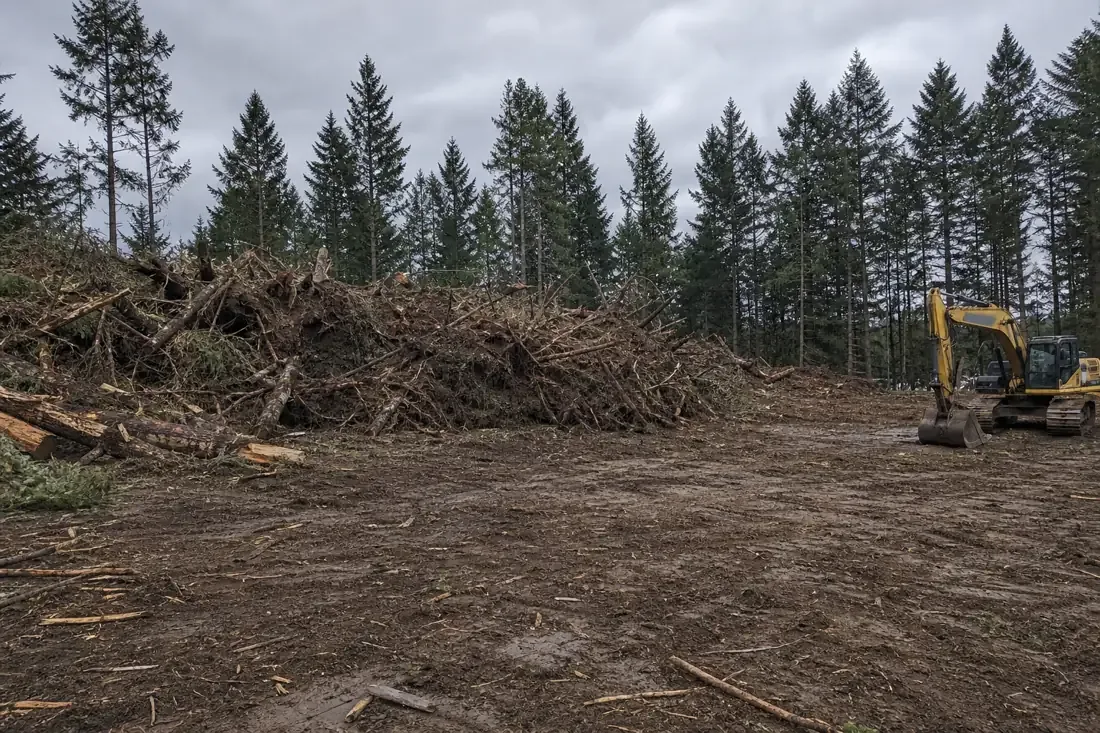
Cleared lot after stump removal and backfill in Beaverton, OR
A graded lot in Beaverton after stump extraction, backfill, and compaction prior to site preparation.

Grinding Versus Full Extraction: Choosing the Right Method

The method question is not which approach is generally more thorough. It is what the cleared ground will carry afterward and how deep into that zone the existing root mass actually reaches. Both methods have correct applications, and choosing the wrong one produces either unnecessary cost or a problem the next contractor on site has to work around.

Understanding which method the project actually requires — before the machine arrives on site — is part of what the excavation contractors in Beaverton, OR confirm during the initial site walk, because arriving with the wrong equipment or the wrong plan adds a second mobilization to the cost.

Why Proximity to Structures and Service Lines Changes the Approach

Stump removal next to a structure, a driveway, a fence line, or a buried service line is a different operation from working in open ground. In Beaverton’s established residential areas, large trees frequently send lateral roots under driveways and alongside fence posts, and those roots often run directly above or alongside buried water, gas, and sewer laterals. Aggressive extraction without locating those utilities first risks damaging lines that serve the property. Washington County requires an 811 call before any ground disturbance, and stump extraction qualifies as ground disturbance regardless of method. The high winter water table across the Tualatin Valley means roots near structures tend to grow shallower and wider than they would in better-drained soils, which expands the horizontal footprint that has to be evaluated before the machine commits to a direction or depth.

Basalt and Silty Clay Below the Surface

Parts of Washington County have basalt a few feet below grade. That rock layer limits how deep a root ball can actually extend, but it also means an excavator doing full extraction will reach refusal before the root mass is entirely free, and the approach has to adapt rather than simply dig deeper. In deep silty-clay areas without shallow rock, roots can extend further and the volume of material extracted is larger than the surface trunk suggested. The distance to nearby structures also determines how aggressively the root ball can be pulled without vibration or ground movement affecting adjacent foundations, footings, or fence posts. That subsurface and proximity assessment is a standard part of the site walk when Beaverton excavation work is being scoped on any parcel with existing trees or tree remnants present.

Scheduling: The End of a Clearing Job or a Standalone Visit

Stump removal is most cost-efficient when it is sequenced into a larger clearing or grading project rather than booked as a dedicated visit. The machine clearing brush and small trees can handle stumps in the same mobilization without a separate setup. The excavator doing site grading can pull root balls as it works through the lot. The dump truck already hauling spoil loads grindings and root material at no additional trip cost. When stump work is treated as the final phase of a clearing job, the overhead of a separate equipment mobilization disappears entirely. That is why stump removal in Beaverton is most commonly quoted and scheduled as part of a broader scope — clearing, grading, or site preparation — rather than as a per-stump standalone call, especially on any lot that will go through grading work afterward.

Standalone stump situations do arise, typically after a storm fells a tree or an arborist removes one and leaves the stump for a later crew to address. In those cases the scope is the stump itself, backfill if the root ball is extracted, and surface restoration to a condition ready for whatever comes next — lawn, gravel, or paving. Before any machine moves, the 811 call is placed to confirm service line locations relative to the stump, and the method is confirmed against what the cleared space will ultimately carry. The Beaverton excavation crew quotes standalone stump work on a site-specific basis because trunk diameter, root ball depth, equipment access width, and proximity to structures all affect the time and method in ways that a flat per-stump rate cannot accurately reflect.

Excavation Services We Provide in Beaverton

Stumps left in place become voids that settle under whatever is built above them — work with excavation contractors in Beaverton, OR who choose the right method before the machine is on site.

Drainage & French Drains

Drainage & French Drains →

Site Preparation

Site Preparation →

Utility Trenching

Utility Trenching →

Grading & Leveling

Grading & Leveling →

Stump Removal by Area

The ground changes from town to town across Washington County. See also our Beaverton excavation overview:

All of it runs on the same crew as our wider excavation work in Beaverton.

Stump Removal in Aloha

Stump Removal in Aloha →

Stump Removal in Bethany

Stump Removal in Bethany →

Frequently Asked Questions

What is the difference between stump grinding and full stump extraction?

Grinding processes the trunk and visible surface roots down to eight to twelve inches below grade and leaves the root ball in place to decay. Full extraction pulls the entire root ball from the ground. Grinding is appropriate when nothing structural will sit above the old root zone. Extraction is required before a foundation, slab, utility trench, or any construction that would be undermined by a decaying root mass leaving voids in the soil below it.

How large is the root ball compared to what I can see above ground?

In the Tualatin Valley’s silty clay, a trunk that is twenty inches in diameter can produce a root ball six feet across and three to four feet deep. Silty clay encourages wider, shallower root systems rather than deep taproots, so the footprint of the root zone is significantly larger than the visible stump suggests. Assuming the root ball is roughly the same size as the trunk leads to underestimating the scope of extraction.

Can I use stump grindings as fill or topsoil on my property?

No. Fresh wood chips from a stump grinder are nitrogen-poor and hydrophobic. Mixed into a lawn area, they cause turf failure as soil microbes consume nitrogen trying to break them down. They are not compactable material and cannot be used as structural fill under any paved or built surface. Grindings are typically hauled off the site or used as surface mulch in path areas where plant establishment is not the goal.

Why does a ground-down stump still cause problems if I’m putting in a foundation or utility line?

Grinding removes only the trunk and the top layer of roots. The root ball below grade remains and continues to decay in the soil. A decaying root mass leaves voids that collapse unevenly, which causes settlement under any structure built above it. If a utility trench or boring operation passes through the same zone, the root mass physically blocks the trench or deflects the tool. The method must match what is going in the ground, not what looks cleared at grade.

How is stump removal priced in Beaverton?

Pricing depends on trunk diameter, root ball depth, the method required, equipment access width on the site, and whether the work is part of a larger clearing or grading project. A standalone mobilization for a single stump carries the full overhead of moving equipment to and from the site. Work sequenced into an existing clearing or grading job distributes that overhead across the broader scope. Site-specific quotes are the only accurate way to price stump work because the variables differ on every parcel.

Do I need to call 811 before stump removal?

Yes. Washington County requires an 811 utility locate call before any ground disturbance, and stump extraction qualifies as ground disturbance. The locate process marks buried water, gas, sewer, electric, and communication lines within the work area. Root systems from large trees frequently run alongside or above those laterals, so knowing their location before the machine starts determines both the safe extraction direction and how aggressively the root ball can be pulled without risking damage to live utilities.
Get Your Free Beaverton Excavation Estimate

Send over the basics of the job and we will visit the property, walk the ground with you, and price the scope in writing — no pressure and no obligation. Call, text, or use the form; we reply the same business day.

We only use your info to contact you about your project. No spam, ever.

Prefer to talk?

Call or text to reach our team directly. During business hours we pick up when we can, and every message gets a return call.

(458) 272-9359

Hours: Mon–Sat, 7am–6pm