Serving Beaverton & all of Washington County, OR Free estimates: (458) 272-9359
Beaverton Excavation Co.

Home › Aloha

Stump Removal in Aloha, OR

Mature stumps on decades-old Aloha lots sit close to foundations, driveways, and buried utilities — removing them correctly starts with knowing what is in the ground before the equipment moves.

Licensed & insured in Oregon Free on-site estimates Local Washington County crew Wet-season ready

Stump removal in Aloha’s established suburban yards is different from clearing stumps on a raw development site. The trees here have been growing in place for decades — long enough for their root systems to extend well beyond what the canopy suggests and to press those roots against foundations, driveways, fences, and buried utility lines along the way. Beaverton Excavation Co. handles stump removal on lots where access is constrained, utilities are close, and the space around the stump is not open ground but finished landscaping, existing concrete, and neighboring structures that cannot be disturbed.

Aloha grew substantially in the postwar decades and again through the 1970s and 1980s. Trees planted at that time — along fence lines, at the front curb, in backyard corners, or alongside driveways — are now mature specimens with substantial trunk diameters and root systems that have had 40 to 60 years to develop. A stump from a tree of that age is not comparable to removing a recently planted tree. The visible stump above grade is a small fraction of what is in the ground. The root ball extends outward and downward well past what the surface profile suggests, and the lateral roots that extend from the base may reach under a driveway, alongside a foundation, or directly over a buried utility line.

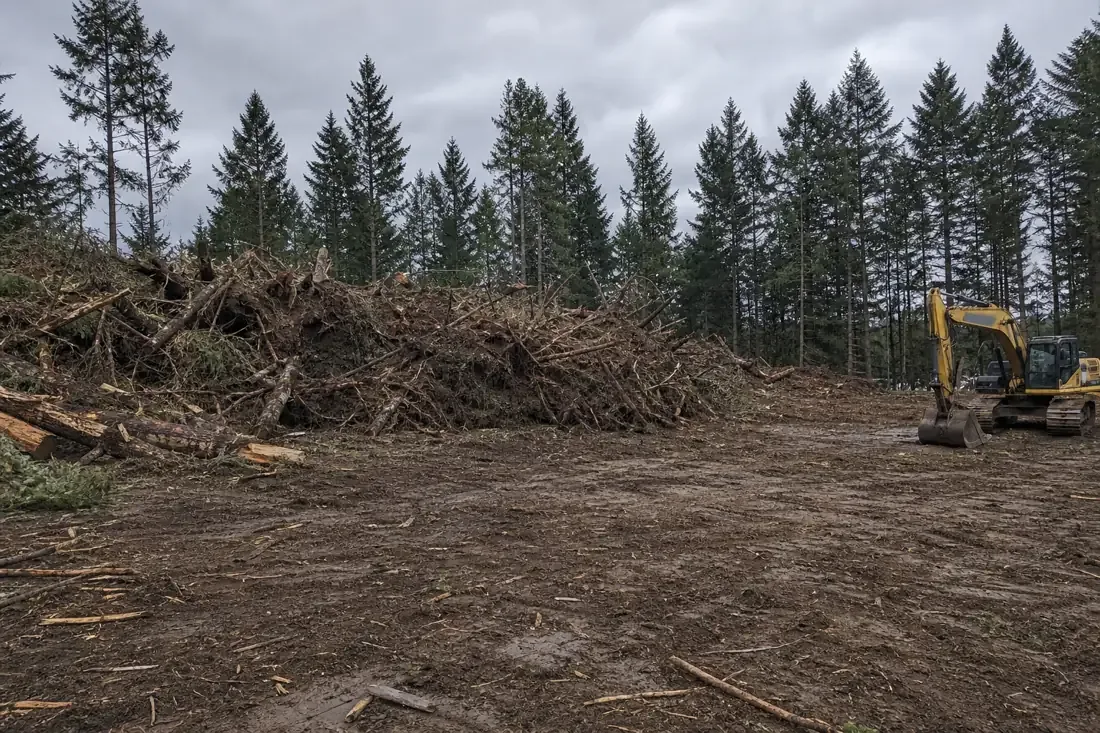
Stump removal work underway in an established suburban yard in Aloha, OR with compact equipment accessing through a side gate
Mature stumps on Aloha’s established lots often sit within feet of a foundation, driveway, or buried utility line, requiring careful equipment access planning and root tracing before cutting starts.

Grinding Versus Full Extraction: Choosing the Right Method for the Job

The two main stump removal methods — grinding and full extraction — produce meaningfully different outcomes. The right choice depends entirely on what the ground will be used for after the stump is gone and what is in the ground around it.

Matching the method to the site conditions and the future use of the area is the first assessment that shapes the rest of the job. Excavation contractors in Beaverton, OR who work established suburban lots regularly know to ask about future use before recommending a method rather than defaulting to whichever one is faster on a given day.

What the Ground Looks Like Under a Mature Stump

The visible stump above grade is a poor guide to the size of the root ball beneath it. A mature tree with a 24-inch trunk diameter can carry a root ball six to eight feet across and three to four feet deep, with flare roots radiating outward from the base that push through clay soil, gravel, and sometimes concrete over their decades of growth. When that root ball is extracted, the void it leaves behind is substantially larger than the surface stump footprint suggested. The soil around the extraction zone is disturbed to a radius that often surprises property owners who assumed the work was confined to the circle of the visible stump. The surrounding ground, loosened and partially undercut during extraction, does not support any load reliably until it is restored with mechanically compacted fill placed in controlled lifts.

Why a Ground-Level Stump Still Blocks Future Work

Grinding a stump to below grade resolves the visual and mowing problem, but the root mass — the horizontal runners extending outward from the base and the vertical tap roots below it — remains in the ground and continues to decay slowly over years. As that wood loses volume, the soil above it settles into the voids the wood occupied. On a lawn, this produces small surface depressions that appear gradually over two or three seasons. On a planned foundation or utility trench route, that decaying mass creates a soil composition and compaction problem: organic material in the bearing zone compresses under structural load, and voids form as the wood breaks down further. Any time a stump sits in the path of a planned foundation slab, driveway extension, or utility trench, full extraction is the correct choice. Our Beaverton excavation crews evaluate each situation and explain why the method matters before any equipment is positioned on the lot.

Access Constraints, Permits, and Cost for Stump Removal in Aloha

The most common access limitation on an Aloha suburban lot is the side gate. Most backyard stumps can only be reached by passing equipment through a gate opening that ranges from 36 to 48 inches wide on typical residential fencing. A standard commercial stump grinder will not fit through those openings. The alternatives are compact track-mounted grinders built for residential access or hand-carry grinding equipment for very confined spaces, both of which take longer than open-site equipment would for an equivalent stump. The access route also matters beyond the gate itself: the path between the gate and the stump may cross irrigation lines, landscape edging, a patio edge, or other yard features that need to be identified and either protected or temporarily moved before equipment is brought through. Aloha’s established lots carry more yard infrastructure in the ground than a newer subdivision lot would.

Stump removal on a residential lot does not typically require a building permit in Washington County, but utility locates through 811 are required before any extraction begins. Cost depends on stump diameter at ground level, the method used, how difficult access is, and whether backfill and compaction are included after extraction. A backyard stump reached through a 36-inch gate in an established yard costs more to remove than the same-diameter stump in an open area, because the equipment options are more limited and setup time is longer. The Beaverton excavation crew assesses each job on-site before pricing it, accounting for access, stump size, root mass extent, and what the ground is being prepared for after the work is complete.

Excavation Services We Provide in Aloha

Aloha homeowners dealing with mature stumps in established yards call excavation contractors in Beaverton, OR who plan the access route, locate utilities, and handle backfill compaction after extraction rather than just grinding to grade and leaving.

Drainage & French Drains

Drainage & French Drains →

Site Preparation

Site Preparation →

Utility Trenching

Utility Trenching →

Grading & Leveling

Grading & Leveling →

Frequently Asked Questions

Should I grind or fully extract a stump in my Aloha yard?

The right method depends on what the ground will be used for after the stump is removed. Grinding works well when the area will be seeded or landscaped and no structure or utility run will pass through the stump zone in the future. Full extraction is necessary when a foundation, driveway slab, or utility trench will run through or near the stump location, because decaying root mass underground causes voids and uneven settlement under load. Grinding leaves that root mass in place; only extraction removes it entirely.

How large is the root ball on a mature tree in an Aloha suburban yard?

Substantially larger than the visible stump suggests. A mature tree with a 24-inch trunk diameter can carry a root ball six to eight feet across and three to four feet deep, with lateral flare roots that extend outward through clay, gravel, and sometimes concrete. When the stump is fully extracted, the void left behind is much larger than the surface footprint implied, and the surrounding soil is disturbed to a radius that requires compacted backfill before the area can carry any load reliably. Property owners frequently underestimate the scope of the subsurface work.

How do you get stump grinding equipment into a backyard through a narrow gate?

Most backyard stumps in Aloha are only reachable through side gates 36 to 48 inches wide. Standard commercial grinders do not fit. The options are compact track-mounted grinders designed for residential access or hand-carry grinding equipment for very tight spaces. Both take longer than open-site equipment would for a comparable stump. Measuring the gate width and planning the equipment path before scheduling prevents arriving on-site with a machine that will not fit, which causes delays and rescheduling costs.

Will the void from a full extraction settle on its own over time?

No. Loose soil pushed back into the extraction void without mechanical compaction will continue to settle unevenly for one to three seasons as it consolidates under its own weight and rain infiltration. Areas intended for foot traffic, vehicles, or any structure require the void to be filled in compacted lifts — adding material in layers and mechanically compacting each layer before adding the next. Skipping compaction produces surface depressions in a lawn or, more seriously, soft spots under a driveway or patio that crack the surface above them.

What does stump removal cost in Aloha, OR?

Stump removal pricing in Aloha is driven by stump diameter at ground level, the method selected (grinding versus full extraction), the access difficulty, and whether backfill and compaction are included. A stump reached through a 36-inch side gate in a developed backyard costs more to remove than the same diameter stump in an open area because equipment options are limited and setup takes longer. Root ball size for mature trees adds further variability. Accurate pricing requires a site visit to assess access, stump size, and root extent before quoting.

Do I need a permit to remove a stump in Aloha?

Washington County does not typically require a building permit to remove a stump on a residential lot in Aloha. However, utility locates through 811 are required before any extraction work begins. Roots from mature trees grow alongside buried utility lines over decades, and pulling a root ball without knowing where those lines are risks damaging a water, gas, sewer, or electrical service. If the tree was a street tree in the public right-of-way, Washington County may have additional requirements worth confirming before scheduling the removal.
Get Your Free Beaverton Excavation Estimate

Send over the basics of the job and we will visit the property, walk the ground with you, and price the scope in writing — no pressure and no obligation. Call, text, or use the form; we reply the same business day.

We only use your info to contact you about your project. No spam, ever.

Prefer to talk?

Call or text to reach our team directly. During business hours we pick up when we can, and every message gets a return call.

(458) 272-9359

Hours: Mon–Sat, 7am–6pm