Serving Beaverton & all of Washington County, OR Free estimates: (458) 272-9359
Beaverton Excavation Co.

Home › Beaverton

Sewer Line Replacement in Beaverton, OR

Camera inspection first, then open-cut or trenchless replacement of failed sewer laterals across Beaverton.

Licensed & insured in Oregon Free on-site estimates Local Washington County crew Wet-season ready

Beaverton Excavation Co. handles sewer lateral replacement in Beaverton, OR — specifically replacement of a failed line, not new installation. The distinction matters because replacement means working around an existing structure, an existing utility configuration, and often an emergency timeline. The failed lateral is diagnosed with a camera before any ground is disturbed, so the scope is defined by what the pipe actually shows rather than by assumption about what typically fails at a given property age.

Older properties in Beaverton were frequently served by clay or cast-iron sewer laterals installed before PVC pipe became standard. Both materials are brittle past middle age and highly susceptible to root intrusion. The Tualatin Valley’s silty clay supports vigorous root systems, and mature tree roots find and enter any joint gap or crack in an aging lateral. Once inside, roots block flow, retain solids, and eventually collapse the pipe from the interior. A lateral that functioned for forty years can degrade rapidly once a large root mass establishes inside it, particularly after a dry summer when roots are actively searching for moisture and any source of water in the soil is attractive.

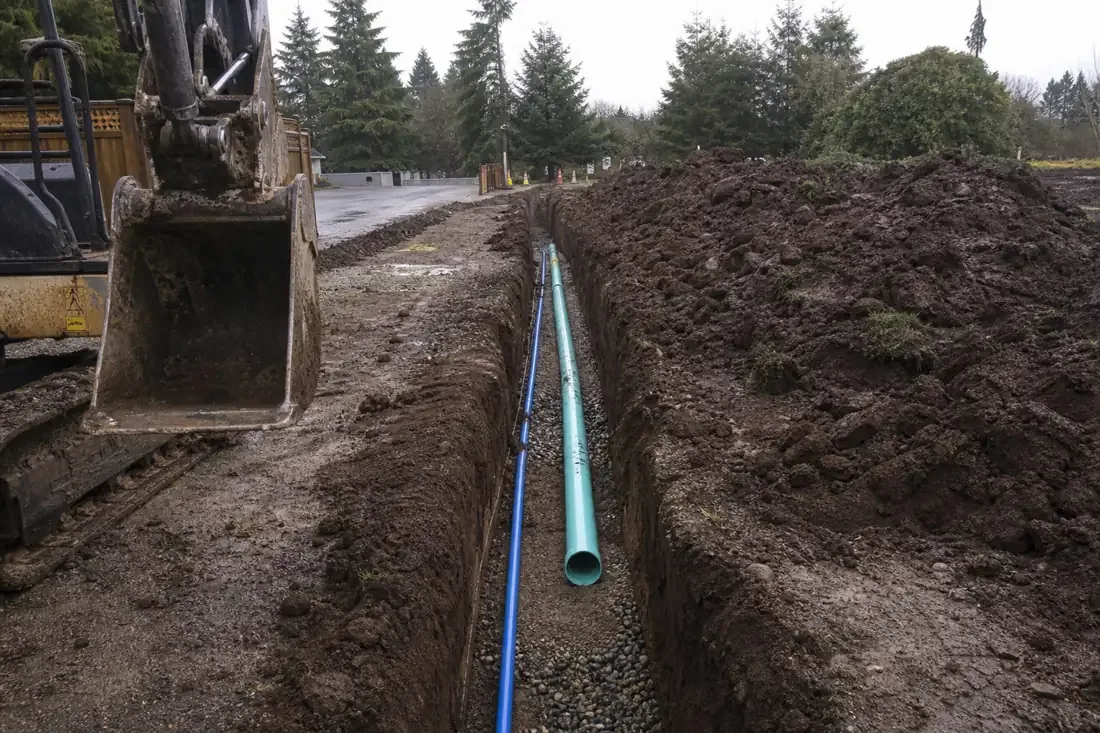
Sewer lateral replacement trench with new pipe in Beaverton, OR
Open-cut sewer lateral replacement in Beaverton, with new PVC pipe bedded and ready for backfill and compaction.

Camera Inspection Before Any Excavation Starts

A camera run through the existing lateral before excavation locates the failure, identifies the pipe material, confirms depth and alignment, and defines exactly what has to come out. Skipping this step and digging based on symptoms alone produces excavations in the wrong location and replacements that miss the actual failure mode. The camera footage determines the method and the scope before a shovel is lifted.

Working with excavation contractors in Beaverton, OR who run camera before committing to a scope keeps the project on budget and prevents the common outcome of digging to the wrong location, then discovering the actual failure point is twenty feet further down the run.

Open-Cut Versus Trenchless: The Method Tradeoff

Open-cut lateral replacement means excavating a trench along the full run of the failed pipe, removing the old line, and installing new PVC with proper bedding material and continuous fall to the main. Open-cut gives complete access to the pipe zone, allows inspection of the surrounding soil for voids left by collapsed clay sections, and produces a replacement that can be visually confirmed for grade and bedding before backfill covers it. The cost is in the excavation itself and in restoring whatever surface material sat above the trench — lawn, gravel, asphalt, or concrete. Surface restoration is a real budget item on any open-cut project and should be scoped from the start rather than treated as an afterthought. On most residential laterals that run under lawn or unpaved surfaces, open-cut is straightforward and produces a result that can be fully inspected before it is buried.

Pipe Bursting and When Trenchless Applies

Trenchless pipe bursting pulls a new HDPE or PVC pipe through the path of the old one by fracturing the existing pipe outward into the surrounding soil. It requires only small entry and exit pits rather than a continuous trench, which makes it the right choice when the lateral runs under a concrete driveway, an expensive hardscape, or a finished surface that would cost significantly more to cut and restore than the trenchless method premium. The tradeoff is that pipe bursting follows the existing pipe path exactly — it cannot correct a sag or realign a section that has shifted out of grade, because the new pipe takes the same trajectory as the failed one. If the camera shows grade problems or significant offsets, open-cut is the only method that corrects the underlying alignment issue. That camera finding drives the method decision when Beaverton excavation is scoping a lateral replacement rather than a general preference for either approach.

Fall, Tie-In, Restoration, and the Emergency Question

A sewer lateral must maintain a consistent fall from the structure to the main without interruption — typically one-quarter inch per foot as a minimum — throughout its entire run. Any section that is flat or has reversed pitch creates a belly where solids settle and accumulate rather than flowing forward. A lateral replaced without verifying grade through every section can re-clog within months of service, requiring excavation again to correct what the first replacement missed. Grade verification is not a final check performed at the end — it drives the excavation depth at each point along the trench as the work proceeds. At the downstream end, the new lateral must tie into the sewer main with a proper connection fitting. In Washington County, the homeowner owns the lateral from the building foundation to the main; the utility owns the main itself and controls access to it. Tie-in at the main requires coordination with the utility and typically a separate permit for work on or adjacent to the main line.

Surface restoration after open-cut replacement is not cosmetic — it is structural. Lawn areas get topsoil and seed or sod. Gravel driveways get compacted aggregate base and surface stone re-spread to match. Asphalt patches require saw-cutting to clean edges, subbase preparation, and a new surface course matched to the adjacent pavement thickness. A trench backfilled in a single dump without compaction in lifts will settle and crack the surface patch within the first wet season. The Beaverton excavation crew backfills lateral trenches in compacted lifts specifically to prevent that settlement, because a failed surface patch over a lateral replacement is the most common callback on this type of work and it is entirely avoidable with correct backfill procedure. Finally, the emergency-versus-planned distinction: a backed-up sewer line is a same-day problem, not a scheduled appointment. A functioning lateral that camera shows is deteriorating can be planned and scheduled. A line that is already backing up means the structure has no drain function and the response timeline is measured in hours rather than weeks.

Excavation Services We Provide in Beaverton

A failed sewer lateral is diagnosed with camera before excavation starts — work with excavation contractors in Beaverton, OR who define the scope from what the pipe actually shows.

Drainage & French Drains

Drainage & French Drains →

Site Preparation

Site Preparation →

Utility Trenching

Utility Trenching →

Grading & Leveling

Grading & Leveling →

Frequently Asked Questions

How do I know if my sewer lateral needs replacement or just cleaning?

Mechanical cleaning clears an obstruction but does not repair structural damage. If the lateral is root-infested throughout, has collapsed sections, cracked or offset joints, or shows sags that re-accumulate solids after every cleaning, the pipe needs replacement. Camera inspection makes that determination definitively. A lateral that required two or more cleaning calls in the past year is typically showing structural deterioration, and the next step is a camera run to assess whether repair or replacement is the right scope.

What is the difference between open-cut excavation and trenchless pipe bursting for a sewer lateral?

Open-cut means excavating a trench along the full run, removing the old pipe, and installing new pipe with verified grade and bedding. It gives full access and allows grade correction. Pipe bursting pulls a new pipe through the old pipe’s path by fracturing the existing pipe outward, requiring only small entry and exit pits. Bursting is cost-effective when the run crosses expensive hardscape, but it cannot correct sags or realign offset sections because the new pipe follows the existing path.

Who owns the sewer lateral — the homeowner or the utility?

In Washington County, the homeowner is responsible for the sewer lateral from the building to the sewer main. The utility owns the main itself. Any work at the tie-in point where the lateral connects to the main requires coordination with the utility and typically a permit for access to or adjacent to the main line. The homeowner bears the cost of the lateral replacement; the utility controls the main-side connection and inspection process.

Why does the grade of a sewer line matter, and what is a belly or sag?

A sewer lateral works by gravity, not pressure. It requires a continuous fall — typically one-quarter inch per foot — from the structure to the main without any flat or reversed sections. A section that has settled below grade creates a low point called a belly or sag where solids accumulate rather than flowing forward. The belly re-clogs regardless of how many times the pipe is cleaned. Replacement that does not correct the grade through that zone will produce the same clogging problem in the new pipe.

What does sewer lateral replacement cost in Beaverton?

Cost depends on the total run length, pipe depth, the method used (open-cut or trenchless), the condition of the tie-in at the main, and the surface material above the trench that requires restoration. A short lateral under lawn costs considerably less than a long run under a concrete driveway requiring saw-cutting, subbase work, and a paved patch. Site-specific camera inspection and a scope-defined quote are the only accurate way to price a lateral replacement because the variables differ significantly on every property.

What do I do if my sewer is backing up right now — can I schedule this in advance?

A backed-up line means the structure has no functioning drain and the situation requires same-day response, not a scheduled appointment weeks out. Camera inspection to diagnose the failure and excavation to replace the line follow on an emergency timeline. A lateral that camera shows is deteriorating but still partially functional can be planned, permitted, and scheduled during a dry period. The distinction between an emergency response and a planned replacement affects both the timeline and the ability to coordinate surface restoration and utility permitting in advance.
Get Your Free Beaverton Excavation Estimate

Send over the basics of the job and we will visit the property, walk the ground with you, and price the scope in writing — no pressure and no obligation. Call, text, or use the form; we reply the same business day.

We only use your info to contact you about your project. No spam, ever.

Prefer to talk?

Call or text to reach our team directly. During business hours we pick up when we can, and every message gets a return call.

(458) 272-9359

Hours: Mon–Sat, 7am–6pm