Serving Beaverton & all of Washington County, OR Free estimates: (458) 272-9359
Beaverton Excavation Co.

Home › Beaverton

Retaining Wall Construction in Beaverton, OR

Drainage behind the wall, footing depth, and batter — the structural factors that determine whether a retaining wall on a Beaverton slope holds or fails.

Licensed & insured in Oregon Free on-site estimates Local Washington County crew Wet-season ready

A retaining wall holds soil in place on a slope or cut where the ground would otherwise move downhill under its own weight. The need for them in Beaverton appears wherever a driveway has been cut into a hillside, a yard has been leveled across a grade change, or a property line runs along a slope. Beaverton Excavation Co. builds retaining walls from base preparation through cap, handling the excavation, drainage installation, and wall construction as a single coordinated scope rather than separate contracts.

The Tualatin Valley’s soil makes retaining wall drainage a technical requirement, not an optional upgrade. Silty clay does not drain freely. During the October through May wet season, it absorbs water and holds it. Saturated clay is substantially heavier than dry clay, and that additional weight translates directly into lateral pressure against whatever is holding it back. A wall built without a drainage system behind it in this region is not a question of whether it will fail — it is a question of how many wet seasons it survives before the hydrostatic pressure wins.

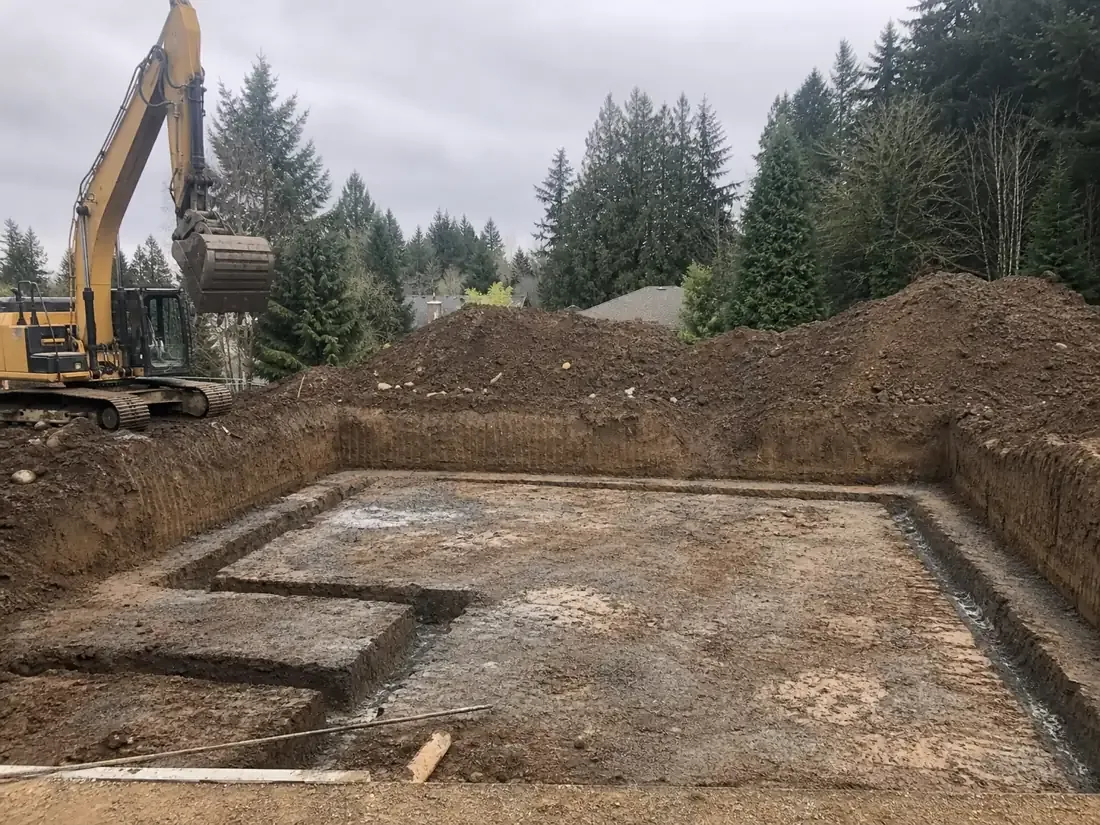
Excavation for a retaining wall footing in Beaverton, OR showing base preparation depth
A properly excavated wall footing reaches below the frost line and into stable, undisturbed native soil before any block or concrete is placed.

What Goes Into a Retaining Wall That Actually Holds

The wall face is the part a property owner sees, but the components behind and beneath it determine whether the wall performs for decades or leans forward in five years. Every wall we build in Beaverton starts with drainage design, footing depth, and batter calculation before any material is chosen for the visible face.

The wall material — concrete block, natural boulders, or poured concrete — is selected after the drainage and structural requirements are established, not before. Each material has site conditions where it performs best. Relying on the excavation contractors in Beaverton, OR to evaluate those conditions before committing to a wall type prevents the most common and expensive mismatch between material and site.

Why Drainage Behind the Wall Matters More Than the Wall Itself in This Region

In most of western Oregon, and particularly in the Tualatin Valley, a retaining wall without a drainage system is a slow-motion failure waiting for the right wet season to complete it. The mechanism is straightforward: silty clay has low permeability, so rainwater that infiltrates the slope above the wall does not drain away quickly. It accumulates in the retained soil mass. Saturated clay exerts hydrostatic pressure — the weight of water pressing laterally against the wall face — in addition to the normal earth pressure that the wall is designed to handle. That combined pressure is substantially higher than the design load a wall built without drainage must resist. Concrete block walls crack at the mortar joints. Boulder walls shift at the base. Even poured concrete walls, the heaviest and most resistant of the three, will rotate forward under sustained hydrostatic pressure if there is no relief for the water to go. The drain rock layer, filter fabric, and perforated drain pipe at the base of that layer are not secondary details; they are what makes the wall work in a wet climate with clay-dominated soil. A properly drained wall reduces lateral pressure to manageable earth pressure alone, which is what the structural design is based on.

Block, Boulder, and Poured Concrete — Matching the Material to the Site

Concrete segmental block is the most common choice for residential walls in Beaverton: it installs in modular units, accepts geogrid reinforcement at specified intervals, and tolerates minor differential settlement without cracking because the dry-stacked units have some flexibility. It works well for walls up to six or eight feet in retained height with proper geogrid and drainage. Natural boulders — large fitted or placed basalt or granite rock — suit sites where aesthetics matter and where the wall height is moderate; boulder walls rely on mass and interlocking geometry for stability rather than geogrid, and they drain naturally because water moves through the gaps. Poured concrete or concrete masonry unit walls make sense for very tall retained heights, for walls with surcharge loads like driveways or structures directly above the wall, or for sites where the wall face must be vertical with no room for a battered front. Our Beaverton excavation work on hillside sites covers all three types, and the choice depends on retained height, surcharge, aesthetics, and how much yard depth is available for a stepped or battered face.

When Wall Height Requires Engineering, Permits, and What Happens When It Doesn’t Get Either

Washington County requires a building permit for retaining walls above a certain retained height, typically four feet as measured from the bottom of the footing to the top of the wall, though the exact threshold can vary depending on surcharge conditions and proximity to property lines. Walls above that threshold must be designed by a licensed engineer and submitted for county review before construction begins. An engineered wall design specifies footing dimensions, drainage requirements, geogrid spacing and embedment depth, and the wall cross-section at each point along the run where conditions change. Hillside lots where Beaverton slopes transition from flat valley floor to steeper terrain frequently require walls above the permit threshold, particularly when cut-and-fill work is used to create a level pad for a driveway, structure, or yard area. Building a wall above the permit threshold without county approval exposes the property owner to a stop-work order, a requirement to demolish and rebuild, and potential liability if the wall fails and damages adjacent property.

The condition that ends a retaining wall’s service life in this region is almost always water, not the age of the material or the type of construction. An undrained wall in Washington County will fail; the only variable is timing. Beaverton’s sloped terrain, its heavy October through May rainfall, and the Tualatin Valley’s clay-dominated soil combine to make hydrostatic pressure a real and measurable force on any wall without drainage relief. When we see a wall that has started to lean forward or show horizontal cracking, the investigation almost always finds saturated soil directly behind the wall face and no evidence of a drain rock layer or outlet pipe. Rebuilding that wall the right way — with excavation behind the existing structure, proper drainage installation, and a new wall set on a solid footing — is more work than building it correctly the first time, but it is the only repair that actually lasts. The Beaverton excavation crew handles both new wall construction and the demolition and rebuild of failed walls across Beaverton’s hillside terrain.

Excavation Services We Provide in Beaverton

For slope work, grading, and excavation across Beaverton’s hillside terrain and valley-floor lots, the excavation contractors in Beaverton, OR provide the site work that keeps the ground in place before, during, and after construction.

Drainage & French Drains

Drainage & French Drains →

Site Preparation

Site Preparation →

Utility Trenching

Utility Trenching →

Grading & Leveling

Grading & Leveling →

Retaining Walls by Area

The ground changes from town to town across Washington County. See also our Beaverton excavation overview:

All of it runs on the same crew as our wider excavation work in Beaverton.

Retaining Walls in Aloha

Retaining Walls in Aloha →

Retaining Walls in Raleigh Hills

Retaining Walls in Raleigh Hills →

Frequently Asked Questions

Why do so many retaining walls in Beaverton eventually lean or crack?

The most common cause is hydrostatic pressure from water building up in the retained soil behind the wall. Tualatin Valley silty clay drains slowly, so rainwater accumulates in the slope during the wet season. That trapped water adds lateral pressure to the wall well above the earth pressure the wall was designed to resist. A wall built without drain rock, filter fabric, and a perforated outlet pipe behind it will eventually fail from this pressure, regardless of how solid the visible wall face looks.

What drainage system does a retaining wall in this area actually need?

At minimum: a layer of clean drain rock directly behind the wall face, a sheet of geotextile filter fabric separating the drain rock from the native clay so fines don’t clog it, and a perforated pipe at the base of the drain rock layer running to a daylight outlet or catch basin. The fabric matters as much as the rock — without it, the clay migrates into the rock over a few wet seasons, the drainage layer silts up, and hydrostatic pressure resumes building against the wall.

When does a retaining wall in Washington County require a permit and engineering?

Washington County generally requires a building permit for walls with retained height above four feet, measured from the bottom of the footing. Walls with surcharge loads — a driveway, structure, or heavy equipment operating above the wall — may require engineering at lower heights. The permitted design must be prepared by a licensed engineer and approved by the county before construction starts. Building above the threshold without a permit risks a stop-work order and a requirement to demolish and rebuild.

What wall material is best for a Beaverton hillside — block, boulder, or poured concrete?

Concrete segmental block suits most residential retaining walls up to six or eight feet in retained height; it accepts geogrid reinforcement and handles minor settlement without cracking. Natural boulders work well for moderate heights where aesthetics matter and drainage through the gaps is acceptable. Poured concrete is the right choice for very tall retained heights, heavy surcharge loads, or where a vertical face is required and no room exists for a battered front. The drainage system behind the wall matters more than which of these three materials is chosen.

How much does retaining wall construction cost in Beaverton?

Cost is driven by retained height, total linear footage, material type, how much excavation the site requires behind the wall, drainage complexity, and whether engineering is needed. A short garden wall on flat ground costs a fraction of a tall structural wall on a steep hillside cut. We evaluate each site before providing a number, because factors like existing soil stability, proximity to structures, and access for equipment vary significantly across Beaverton’s hillside terrain and change the scope of work considerably.

How long does retaining wall construction take in Beaverton, and does the wet season affect timing?

A straightforward residential wall on a accessible site typically takes several days to a week from excavation through cap placement. Longer runs, taller walls, and sites requiring significant excavation or engineered backfill take longer. The October through May wet season complicates construction: saturated clay is harder to compact, and freshly placed concrete needs protection from freezing temperatures. We schedule wall work with those conditions in mind, and walls that need to be built during the wet season are staged and covered to protect the base and footing work.
Get Your Free Beaverton Excavation Estimate

Send over the basics of the job and we will visit the property, walk the ground with you, and price the scope in writing — no pressure and no obligation. Call, text, or use the form; we reply the same business day.

We only use your info to contact you about your project. No spam, ever.

Prefer to talk?

Call or text to reach our team directly. During business hours we pick up when we can, and every message gets a return call.

(458) 272-9359

Hours: Mon–Sat, 7am–6pm