Serving Beaverton & all of Washington County, OR Free estimates: (458) 272-9359
Beaverton Excavation Co.

Home › West Slope

Excavation Contractor in West Slope, OR

West Slope properties are older and on a grade — two conditions that compound each other when original drainage and retaining work starts to fail.

Licensed & insured in Oregon Free on-site estimates Local Washington County crew Wet-season ready

West Slope covers 1.7 square miles of land east of Cedar Hills, northwest of Raleigh Hills, and south of U.S. Route 26 — a small, compact area that is literally the western slope of the Portland west hills. Beaverton Excavation Co. works here regularly, and the conditions that define excavation work in West Slope are as much about age as they are about grade. The community has the oldest demographic profile of the Washington County communities we serve, and that demographic reality translates directly into the housing stock: the original site work on many West Slope properties was built to standards that are now decades past their design life, and those systems are showing it in ways that range from visible water problems to structural movement that has developed gradually over many years.

Drainage lines installed when a house was built in the 1960s or 1970s were sized for the loads they faced then, in materials that were considered acceptable at the time, to standards that engineering practice has since revised. When those lines begin to fail — through undersized capacity, collapsed sections, root intrusion, or degraded pipe material — the failure rarely announces itself clearly. Water appears where it did not before. A foundation wall develops seepage that was not present ten years ago. A retaining wall that stood for decades begins to tilt noticeably. Excavation on an older West Slope property often starts with exposing what is actually there, because guessing at conditions that predate modern site documentation produces the wrong repair plan and wastes the cost of the correction.

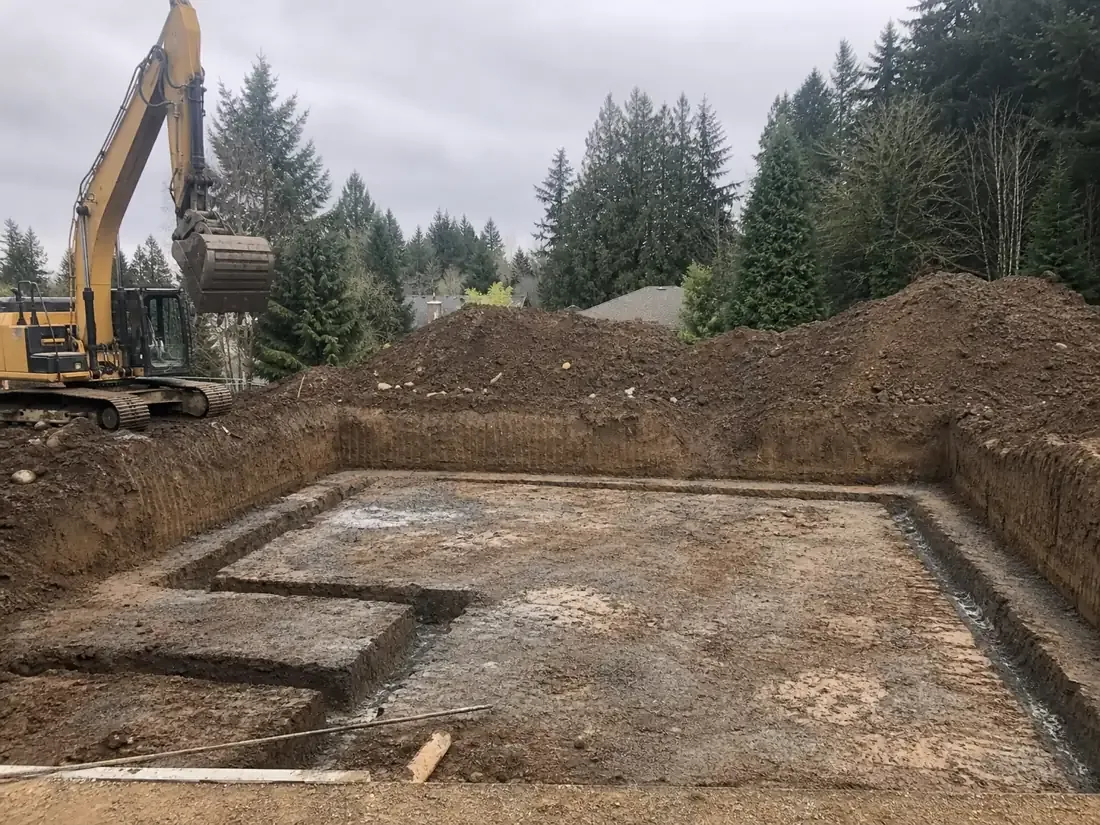
Foundation excavation on an older residential property in West Slope, OR
Exposing the foundation perimeter on an older property frequently reveals drainage conditions that have changed significantly since the original construction.

What Fails on an Older Sloped Property

Age and slope compound each other in a specific way. On flat ground, a drainage system that is undersized or partially blocked causes water to accumulate locally and remain there. On a slope, the same failure causes water to move — often along the path of least resistance, which may be along a foundation wall or beneath a retaining structure rather than through the drain that was intended to carry it.

Identifying which of these failures is present — and how they interact with each other — is what makes older sloped properties different from newer construction where site work is recent and documented. Excavation contractors in Beaverton, OR who work older properties routinely understand that the plan for a West Slope job must account for a discovery phase rather than assume the conditions match what appears on a permit drawing from fifty years ago.

Working Around What Cannot Simply Be Replaced

One practical constraint on excavation work in West Slope is that many properties have mature landscaping and established hardscape that property owners do not want to lose and that cannot simply be cleared and re-laid. A decades-old established screen, a flagstone patio that has settled into position over two decades, a stone retaining wall that is still mostly structurally sound but needs drainage relief behind it — these are features that represent real value and real replacement cost. The challenge is that some of this established material sits directly in the path of the work that needs to happen to address the drainage or structural problem. Careful excavation around mature root systems, hand-digging near established plantings, and precise machine placement to protect hardscape edges are all slower and therefore more costly than open-site work. That added cost is real and belongs in any honest estimate for an older West Slope property rather than discovered after the job has started.

Why You Find Out by Exposing, Not by Guessing

The alternative to careful exploratory excavation on an older property is guessing at conditions, and guessing produces the wrong repair plan often enough that it is not a reliable approach. A camera inspection of an accessible pipe run shows what that section looks like inside; it does not show the condition of the foundation drain that was hand-dug in 1965 and never formally recorded. An older retaining wall may appear stable from the visible face while the drainage fill behind it has collapsed entirely, leaving it held in place by soil friction rather than by designed structure and drainage. The only way to know what is actually there is to open the ground carefully at the relevant points, examine what is exposed, and build the repair scope from what is actually found. Our Beaverton excavation approach on West Slope properties accounts for this by building exploratory scope into the work plan rather than committing to a fixed repair sequence before conditions on the ground have been confirmed.

Permits, Timing, and Why Deferred Problems Cost More

West Slope is served by Tualatin Valley Fire & Rescue, and all excavation work in Washington County requires 811 utility locates before any digging begins. Sites disturbing an acre or more trigger Oregon DEQ 1200-C stormwater permit requirements; most West Slope residential projects fall under that threshold but are still subject to Clean Water Services erosion-control rules during the October through May wet season. On a sloped property, those rules require real measures — silt fencing, stabilized access, and protected storm drain inlets — because slope water moves and carries material with it. The cost of compliance is fixed and predictable; the cost of a stop-work order for non-compliance, or of sediment discharge triggering a Clean Water Services notice, is neither fixed nor predictable and is invariably higher than compliance would have been.

The most consistent finding on older West Slope properties is that deferred drainage maintenance does not stabilize; it compounds. A partially blocked perimeter drain allows hydrostatic pressure to build against a foundation wall slowly over years, and the wall eventually shows the result. A leaning retaining wall that is not addressed continues to move until the consequences of movement become unmanageable. A grade reversal that directs water toward a structure continues directing it there with every rain through every wet season. The Beaverton excavation crew works on West Slope properties where deferred problems have developed over many years, and in every such situation the cost to correct the condition exceeded what earlier intervention would have required. Addressing a drainage failure on a sloped older property when it first becomes visible costs substantially less than addressing it after the structure it was failing to protect has experienced years of the resulting damage.

Excavation Services We Provide in West Slope

West Slope sits on the western slope of the Portland west hills in Washington County, where older housing stock and sloped ground make for site work different from new construction — talk to excavation contractors in Beaverton, OR who work this terrain regularly.

Drainage & French Drains

Drainage & French Drains →

Site Preparation

Site Preparation →

Utility Trenching

Utility Trenching →

Grading & Leveling

Grading & Leveling →

Specialist Excavation Work in West Slope

Older properties on the west slope bring a distinct set of problems, so these have their own pages. For the rest, see our Beaverton excavation overview:

On an older sloped lot the fault is usually upstream of the symptom. Our excavation crew finds what is actually there before quoting a fix.

On an older sloped lot the fault is usually upstream of the symptom. Our excavation crew finds what is actually there before quoting a fix.

All West Slope services

Demolition

Demolition →

Gravel Driveways

Gravel Driveways →

Foundation Excavation

Foundation Excavation →

Site Preparation

Site Preparation →

Frequently Asked Questions

How do you diagnose drainage problems on an older West Slope property?

The starting point is exposing the system rather than guessing at it from the surface. A camera inspection shows conditions inside accessible pipe runs but does not reveal connections, outfall conditions, or the state of drainage fill behind retaining walls. Exploratory excavation at key points — the foundation perimeter, the base of a leaning retaining wall, the upstream end of a suspect drain run — reveals what no surface inspection can. On an older property, assuming the installed system matches any permit drawing is not a reliable starting assumption.

Can you work around mature trees and established landscaping on a West Slope property?

Yes, though it takes planning and adds time to the project. Hand-digging near established root systems, careful machine positioning to protect hardscape edges, and protective measures around significant plantings are standard practice on mature properties. The constraints are real: areas a machine would clear in minutes may require hours of careful hand work. An honest estimate for excavation on an older West Slope property accounts for those constraints rather than pricing the job as if the site were open ground.

What are the warning signs that original drainage on an older sloped property has failed?

Common indicators include water in a basement or crawl space that was previously dry, seepage along a foundation wall rather than at a specific point source, a retaining wall that has developed a lean it did not have previously, soft or saturated ground on the upslope side of a structure that persists well after rain ends, and erosion channels on a slope where none existed in prior years. On a slope, failed drainage does not stay local — it migrates, and the effects commonly appear downslope of where the actual failure is.

What does excavation work cost on an older West Slope property?

Older sloped properties carry cost factors that newer or flatter sites do not: exploratory scope to confirm what is actually present before committing to a repair sequence, careful work practices near mature landscaping and established hardscape, repair or replacement of drainage infrastructure that may be undersized or failed, and potential retaining work that involves both excavation and structure. The specific cost depends on what the site reveals once exposed, which is why any estimate for an older West Slope property requires a site visit and plans for a discovery phase.

How long does drainage repair or excavation work take on a West Slope property?

Duration depends on what the exploratory phase finds, how much infrastructure requires replacement or repair, and whether retaining wall work is part of the scope. A straightforward drainage line replacement on an accessible run can be completed in a day or two. A project that involves exposing a foundation perimeter, replacing a failed drain system, and rebuilding a retaining wall takes longer and is typically scheduled in defined phases. Work during the October through May wet season requires erosion control setup and takedown that adds time at the start and end of each phase.

What permits are needed for excavation in West Slope?

West Slope falls within Washington County jurisdiction, which requires 811 utility locates before any excavation begins. Work that involves changing site grades, installing drainage infrastructure, or building or replacing retaining walls requires grading or building permits depending on scope and wall height. Sites disturbing an acre or more trigger Oregon DEQ 1200-C stormwater permit requirements. Most residential projects in West Slope fall under the acre threshold but must still comply with Clean Water Services erosion-control rules that apply throughout the October through May wet season.
Nearby Communities We Serve

Raleigh Hills

Beaverton excavation contractor

Get Your Free Beaverton Excavation Estimate

Send over the basics of the job and we will visit the property, walk the ground with you, and price the scope in writing — no pressure and no obligation. Call, text, or use the form; we reply the same business day.

We only use your info to contact you about your project. No spam, ever.

Prefer to talk?

Call or text to reach our team directly. During business hours we pick up when we can, and every message gets a return call.

(458) 272-9359

Hours: Mon–Sat, 7am–6pm