Serving Beaverton & all of Washington County, OR Free estimates: (458) 272-9359
Beaverton Excavation Co.

Home › West Slope

Gravel Driveways in West Slope, OR

A gravel driveway that has been patched for years on a West Slope grade needs a base rebuild, not another layer of rock on top of the same failed conditions.

Licensed & insured in Oregon Free on-site estimates Local Washington County crew Wet-season ready

A gravel driveway on a West Slope hillside property does not fail because gravel is a bad surface. It fails because the base it was built on was never adequate, or because water was never properly managed across it, or because the rock size chosen was correct for a flat surface but not for a grade. When a property owner contacts Beaverton Excavation Co. about a driveway that has been getting worse every winter for years, the first conversation is about why it failed — because a driveway rebuilt on the same conditions that destroyed the first one will follow the same path.

West Slope is, as the name states, a slope — 1.62 square miles of hillside residential land on the western face of the Portland west hills. Driveways here were commonly built decades ago on properties where the original site work was done to the standards of the time. The housing stock in this community is among the oldest in the unincorporated areas adjacent to Beaverton, and the driveways have aged with the houses. What passes for a gravel driveway on many of these properties today is actually a patch history: a layer of rock added when the surface got bad enough to complain about, another layer added a few years later, and a surface that is more rut-filling than it is base construction. That layered patch history does not have a functioning base under it, and each winter it gets worse rather than better.

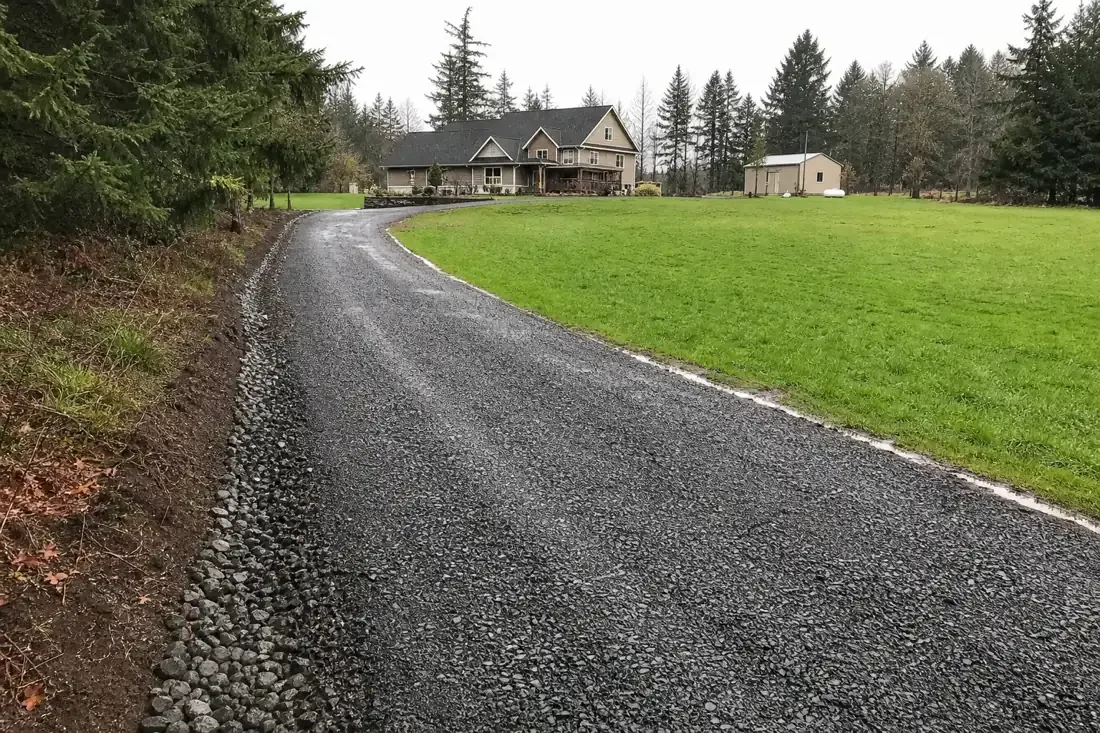
Gravel driveway rebuild on a sloped West Slope property with cross-drain pipe installation and compacted base before rock placement
A driveway rebuild on a West Slope grade means excavating the failed material out before any new base goes in.

What a Proper Driveway Rebuild on a Hillside Lot Actually Involves

A driveway that has been failing for years cannot be fixed by adding more rock. The failure is below the surface, and the fix is below the surface. Every component of a correct rebuild on a sloped West Slope property exists because the original construction did not address the conditions that a sloped driveway actually faces: water running the length of the drive, rock creeping downhill with each vehicle pass, and a base that softens every wet season because water cannot escape.

A driveway rebuilt this way has a functioning base, managed drainage, and an aggregate surface that does not disappear down the hill every winter. It still requires periodic maintenance — gravel driveways on grades always do — but the maintenance is routine re-grading and minor top-dressing rather than another full rebuild. The excavation contractors in Beaverton, OR who do this work correctly build the drainage solution into the drive itself rather than treating it as an afterthought.

What Makes a Sloped Driveway Fail and How the Rebuild Prevents It

Water is the mechanism that destroys every gravel driveway on a grade. It does not announce its presence in a single storm; it works incrementally. In the first season, water running down the drive surface begins separating fine material from coarse and moving it to the bottom. By the second or third season, the base is compromised in the low points where that separated material has accumulated. By the time a property owner calls for help, the ruts are deep enough to collect standing water, the cross-slope is gone, and whatever surface rock was added in the interim has redistributed itself to the bottom quarter of the drive where gravity and flow have concentrated it. The failure is not a surprise — it is the predictable result of building on a grade without managing the water that will run down that grade every winter for decades.

Rock Size and Grade: Why the Same Aggregate Does Not Work Everywhere

A 3/4-inch washed round rock that performs well on a flat driveway rolls freely under vehicle tires on a 10-percent grade. Angular crushed aggregate in a well-graded size blend — material that includes fines, mid-range particles, and coarse particles in the right proportions — compacts to a stable surface where the particle shapes interlock and resist displacement. On a steep West Slope driveway, the aggregate specification matters more than it does on a flat lot, and the difference between choosing correctly and choosing the cheapest available rock shows up in surface longevity within the first few wet seasons. Our Beaverton excavation team recommends aggregate based on the grade and traffic load of the specific driveway rather than applying a single spec to every project.

Maintenance Expectations and What an Honest Timeline Looks Like

A gravel driveway that has been properly built from the base up on a West Slope grade still needs maintenance — that is the honest answer, and property owners who go in expecting otherwise are disappointed when the first wet season produces ruts in the section where a water bar needs re-cutting. The difference between a well-built drive and a patched one is not whether maintenance is required; it is what kind of maintenance is required and how often. A drive with a functioning base and working drainage needs the water bars re-cut periodically, occasional cross-slope restoration in high-traffic areas, and a surface top-dress every few years as the finest aggregate gradually works its way below vehicle level. A patched drive needs all of that plus periodic full sections that failed because the base was never correct. Knowing which situation you are dealing with before work begins is why the diagnosis step exists.

Washington County does not typically require permits for gravel driveway maintenance or rebuilds that stay within the existing driveway footprint, but any work that changes drainage patterns, adds impervious area, or affects a property line may require review. Clean Water Services has jurisdiction over erosion control for ground-disturbing work in Washington County, and a driveway rebuild that involves significant grading may need an erosion-control plan filed before work starts. Permit requirements depend on the scope of the specific project. The Beaverton excavation crew reviews the scope of each project against current Washington County and Clean Water Services requirements before mobilizing, so the owner knows what is required and what the timeline looks like before a shovel goes in the ground.

Excavation Services We Provide in West Slope

When a hillside driveway keeps failing, the problem is below the surface; reach excavation contractors in Beaverton, OR who diagnose before they rebuild.

Drainage & French Drains

Drainage & French Drains →

Site Preparation

Site Preparation →

Utility Trenching

Utility Trenching →

Grading & Leveling

Grading & Leveling →

Frequently Asked Questions

Why does my West Slope gravel driveway keep getting worse every winter?

Water running down the grade separates fine particles from coarse ones and moves them downhill with each storm. Over time the base loses its fine material, which is what holds the structure together, and what remains is loose rock sitting on a surface that has lost its bearing capacity in the wettest sections. Adding more rock on top of that process delays it by a season or two but does not stop it because the drainage that would stop it was never built into the driveway in the first place.

Do you excavate out the old material or add new rock on top of it?

We excavate out the failed material. Adding new aggregate on top of a compromised base produces the same failure on a slightly longer timeline because the base problem is still there. The old surface and whatever depth of base material beneath it has lost its structure comes out completely, the subgrade is inspected and corrected where needed, and then new base material is placed and compacted in lifts before the surface aggregate goes on. That sequence costs more up front but does not require a repeat rebuild in three seasons.

What are water bars and do I need them on my driveway?

A water bar is a shallow channel cut diagonally across the driveway surface that intercepts sheet flow running down the grade and diverts it to the side before it gains enough volume to erode the base material. On a West Slope hillside driveway of any significant length, water bars are typically needed at intervals determined by the grade and the amount of drainage area feeding the surface. They need periodic re-cutting as vehicle traffic gradually fills them in, but that maintenance is simple compared to managing a driveway base that has been eroded by uncontrolled surface flow for years.

What aggregate size works best on a steep gravel driveway?

Angular, well-graded crushed aggregate compacts to a surface where particle shapes interlock and resist displacement under vehicle traffic. Round washed rock rolls freely on a grade under tires and migrates downhill. The specific gradation — the blend of fines, mid-range, and coarse particles — depends on the slope angle and how much traffic the driveway carries. We recommend aggregate based on the conditions of the specific driveway rather than applying a single standard specification to every hillside job in the area.

How is a gravel driveway rebuild on a West Slope grade priced?

Cost depends on driveway length, grade, existing base depth that needs to come out, cross-drain locations and sizes needed, and the condition of the subgrade once the failed material is removed. On a hillside lot where material removal requires hauling off the property rather than redistributing on-site, haul-off volume affects cost. A driveway that looks like a simple resurface from above sometimes turns out to have three feet of failed, uncompacted material under the surface once excavation begins. Diagnosis before pricing is what keeps the final cost from diverging significantly from the initial estimate.

How long does a gravel driveway rebuild take, and when should it be done?

Most residential driveway rebuilds on West Slope properties take one to three days for a crew with the right equipment, not counting any permit review time. The best window for the work is late spring through summer, when soils have drained and the subgrade can be evaluated and corrected without working in standing water. Driveways rebuilt during the wet season often encounter saturated subgrade that cannot be properly compacted, which means the base may not reach design density before the surface aggregate goes on. Spring and summer scheduling also allows the completed base to consolidate through a dry period before the first winter traffic loads hit it.
Get Your Free Beaverton Excavation Estimate

Send over the basics of the job and we will visit the property, walk the ground with you, and price the scope in writing — no pressure and no obligation. Call, text, or use the form; we reply the same business day.

We only use your info to contact you about your project. No spam, ever.

Prefer to talk?

Call or text to reach our team directly. During business hours we pick up when we can, and every message gets a return call.

(458) 272-9359

Hours: Mon–Sat, 7am–6pm