Serving Beaverton & all of Washington County, OR Free estimates: (458) 272-9359
Beaverton Excavation Co.

Home › Beaverton

Septic System Installation in Beaverton, OR

From percolation testing through county final inspection — septic installation sized for Washington County’s soil and seasonal water table.

Licensed & insured in Oregon Free on-site estimates Local Washington County crew Wet-season ready

A septic system is the complete onsite solution for treating and disposing of all wastewater from a property that isn’t connected to a municipal sewer line. For parcels in Beaverton and the surrounding unincorporated sections of Washington County, that means a buried tank, a network of distribution piping, and a drainfield where clarified effluent slowly disperses into the soil below. Beaverton Excavation Co. manages the full installation scope: site excavation, tank setting, drainfield trenching, and backfill sequenced around Washington County’s required inspection hold points so nothing gets covered before a county inspector has signed off.

The soil under most of the Tualatin Valley defines what kind of system a given property can support — and that conversation starts before any permit application is filed. Tualatin Valley silty clay has a slow percolation rate, meaning water moves through it at a fraction of the speed it would through sandy loam. Washington County’s design rules account for this directly: slow-perc soils require more drainfield absorption area to handle the same daily wastewater load, or they require an engineered alternative system altogether. Understanding what the soil actually does before the system is designed is not optional; it determines the permit, the footprint, the cost, and whether the system will still be functioning ten years from now.

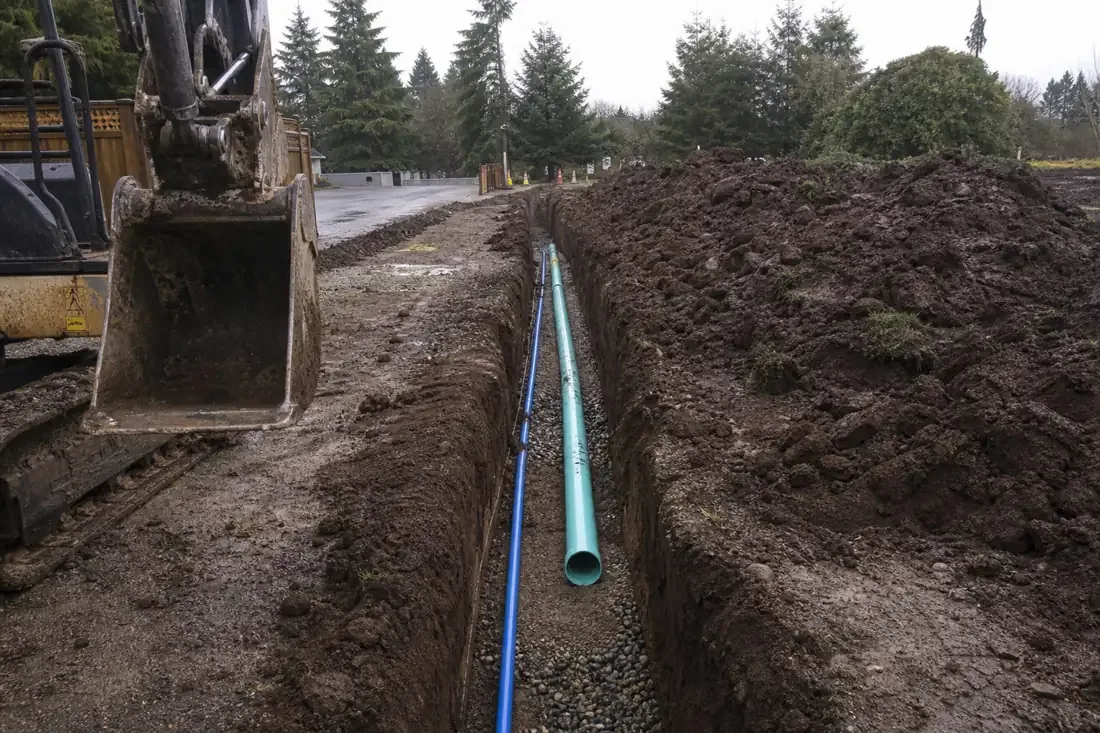
Utility trenching and perforated pipe installation for a septic drainfield in Beaverton, OR
Drainfield trenches are cut to a consistent grade so effluent distributes evenly across every lateral before backfill.

What a Septic System Installation Involves From Start to County Sign-Off

Installing a septic system is a regulated, multi-stage project that starts with soil science and ends with a county inspection before the system goes into service. Every element — tank volume, drainfield area, pipe depth, tank setbacks — is calculated from site-specific data before excavation begins. Rushing the sequence, or guessing at sizing, produces a system that saturates and fails faster than anyone expects.

Each of these steps feeds into the next one. A misstep at the perc test stage can produce an undersized drainfield that saturates in a few wet seasons. When the design and installation are executed correctly from the start, the system functions passively for decades with minimal maintenance. For guidance on what the site evaluation results mean for your specific parcel, the excavation contractors in Beaverton, OR can walk through the findings before any design work is finalized.

Why Tualatin Valley Silty Clay Changes Drainfield Design and What the Winter Water Table Does to It

Silty clay is the dominant soil across much of the Tualatin Valley floor, and its behavior is the central engineering challenge in septic design for this area. Clay particles are fine and tightly packed. They accept water, but far more slowly than the sandy or loamy soils that conventional septic sizing tables assume. A percolation test in Tualatin Valley silty clay often returns a rate slow enough to disqualify a standard gravity-fed drainfield entirely — the soil simply cannot absorb effluent at the rate a conventional system releases it. The engineer’s response is either to increase the drainfield area substantially to compensate for the slow absorption rate, or to redesign the system as an engineered alternative: a mound system built above grade, or a pressure-dosed field that distributes effluent in timed cycles rather than as continuous flow. Both approaches cost more to install and require more yard space than a conventional drainfield, but they are the technically correct answer for the actual soil conditions on site — not a premium upgrade.

High Winter Water Table and Why It Matters Specifically for Drainfield Function

The October through May wet season raises the water table across the Tualatin Valley significantly above its summer position. For a drainfield, that seasonal rise has a direct mechanical consequence that is easy to explain: the drainfield only works when there is unsaturated soil below the trench bottom for aerobic bacteria to treat effluent as it moves downward. When the seasonal water table rises close to the drainfield elevation, that biological treatment zone compresses or disappears. Effluent backs up toward the tank, the soil in the field stays permanently saturated, and the system begins to fail on a seasonal schedule even if it functioned fine through summer. This is why site evaluations must include wet-season soil observations, not just summer percolation tests. A system designed using summer water table readings alone is likely undersized for the conditions it will actually face from October through May. Our Beaverton excavation work on septic systems always incorporates the full site evaluation data, including seasonal high water observations, before any design dimensions are set.

Washington County Permitting, the Inspection Sequence, and Reading Failure Symptoms Before They Become an Emergency

Washington County processes onsite septic permits through its Land Use and Transportation department. The required sequence is: a licensed site evaluator tests the soil and measures seasonal water table conditions, a system designer uses that data to prepare a permitted design, county staff review and approve the design, and only then does excavation begin. During construction, county inspectors review tank placement and drainfield layout before trenches are backfilled — these are hard hold points. Any change to the approved design during construction, whether moving a tank location, adjusting drainfield length, or changing pipe burial depth, requires a formal permit amendment before work continues. When the project disturbs an acre or more of soil, the Oregon DEQ 1200-C stormwater permit also applies and must be in place before excavation starts. Washington County takes onsite wastewater seriously because a failing system does not just affect the property owner; it creates a public health issue and, under Clean Water Services rules, a potential surface water contamination problem for the broader watershed.

Recognizing failure symptoms early is the difference between a targeted repair and a full drainfield replacement. Symptoms divide into two categories that help isolate where the problem is. Slow drains throughout the house, gurgling sounds in the plumbing after flushing, or a sewage backup at the lowest fixture almost always trace back to the tank or the inlet line — root intrusion through a pipe joint, a cracked or collapsed baffle, or a blocked pipe between the house and the tank. These are tank-side problems. The drainfield shows its problems in the yard: spongy or consistently wet ground over the field area, a persistent sewage odor without any indoor drain symptoms, or an unusually lush and green grass strip directly above the field laterals. By the time sewage is surfacing visibly, the drainfield soil has been overloaded for weeks and a biological layer called biomat has sealed off much of the absorption area. The Beaverton excavation crew can open the field and expose the laterals to determine whether the failure is isolated to one distribution line or whether the full drainfield area has reached end of life and needs replacement.

Excavation Services We Provide in Beaverton

For excavation work across Beaverton’s unincorporated lots and established neighborhoods, the excavation contractors in Beaverton, OR handle utility trenching, grading, drainfield work, and site prep under one crew.

Drainage & French Drains

Drainage & French Drains →

Site Preparation

Site Preparation →

Utility Trenching

Utility Trenching →

Grading & Leveling

Grading & Leveling →

Frequently Asked Questions

Why does the Tualatin Valley soil make septic installation more complicated than in other areas?

Tualatin Valley silty clay has a slow percolation rate, meaning it absorbs water much more slowly than sandy or loamy soils. Standard septic sizing assumes faster-draining soil. In this area, a perc test often returns results slow enough to require either a larger-than-standard drainfield or an engineered alternative system such as a mound or pressure-dosed field. Neither option is a shortcut — they are the correct design response to what the soil actually does.

How does the high winter water table in Washington County affect drainfield performance?

A drainfield works by releasing effluent downward through unsaturated soil where aerobic bacteria treat it. When the seasonal water table rises close to the trench bottom during the October through May wet season, that treatment zone shrinks or disappears. Effluent backs up, the field saturates, and the system fails on a predictable seasonal schedule. Site evaluations must include wet-season water table measurements, not just summer readings, to design a system that will work year-round.

How do I tell whether I have a tank problem or a drainfield problem?

Tank problems show up inside the house: slow drains, gurgling after flushing, or a backup at the lowest fixture. These usually indicate a blocked or damaged pipe, baffle, or inlet between the house and the tank. Drainfield problems show up in the yard: persistently wet or spongy ground over the field area, a sewage smell outdoors without any indoor symptoms, or an unusually green strip of grass above the laterals. Both need attention, but they call for different repairs.

What setbacks apply to septic tank placement in Washington County?

Oregon rules specify minimum distances between a septic tank and the house foundation, property lines, drinking water wells, and surface water features. The exact distances depend on the type of water source and the county’s adopted rules. Drainfield setbacks from the same features are typically greater than tank setbacks. These distances are reviewed during the permit process, and a design that doesn’t meet setbacks will not receive county approval regardless of how the rest of the system is designed.

What does a septic system installation cost in Beaverton?

Cost depends on soil conditions, system type, drainfield size, site access, and how much rock or groundwater the excavation encounters. Conventional gravity systems cost less than engineered alternatives like mounds or pressure-dosed fields. Difficult soil — slow perc, high water table, or rock close to the surface — increases both the required system size and the excavation cost. We evaluate each site individually because no two parcels in this area have identical soil conditions, and a number given before the site evaluation is not a reliable figure.

When does a septic installation require an Oregon DEQ 1200-C stormwater permit?

The Oregon DEQ 1200-C permit applies to construction sites disturbing one acre or more of soil. Many residential septic installations on standard lots do not reach that threshold on their own, but if the septic project is part of a larger site development — a new home build, a land division, or a significant re-grading project — the total disturbed area may trigger the requirement. Washington County and DEQ check this during the permit review, and the permit must be in place before any excavation begins.
Get Your Free Beaverton Excavation Estimate

Send over the basics of the job and we will visit the property, walk the ground with you, and price the scope in writing — no pressure and no obligation. Call, text, or use the form; we reply the same business day.

We only use your info to contact you about your project. No spam, ever.

Prefer to talk?

Call or text to reach our team directly. During business hours we pick up when we can, and every message gets a return call.

(458) 272-9359

Hours: Mon–Sat, 7am–6pm