Serving Beaverton & all of Washington County, OR Free estimates: (458) 272-9359
Beaverton Excavation Co.

Home › Raleigh Hills

Foundation Excavation in Raleigh Hills, OR

A daylight basement or stepped foundation cut into a Raleigh Hills hillside requires shoring, upslope water interception, and backfill drainage — not just a bigger excavator.

Licensed & insured in Oregon Free on-site estimates Local Washington County crew Wet-season ready

Excavating a foundation on a hillside is a different scope from the same work on a flat lot. On a flat site, the excavation is a box dug down to the required depth with four relatively stable walls. On a slope in Raleigh Hills, the cut face on the uphill side may be six to ten feet tall, water is moving laterally through the site toward the open excavation, and the access for equipment and spoil trucks has to work around the grade. Beaverton Excavation Co. handles hillside foundation excavations throughout the Washington County southwest hills, where the terrain requires the kind of site management that flat-ground foundation work does not.

Raleigh Hills sits in the elevated terrain at the intersection of Oregon Routes 10 and 210, with a population of 6,196 across a hillside community bounded by Beaverton to the west and West Slope to the north. Daylight basements and stepped foundations are common here because the grade makes them practical — the downhill face of the structure can open to grade while the uphill side is fully buried. That geometry produces a cut face that has to remain stable for the duration of the project, which may be months.

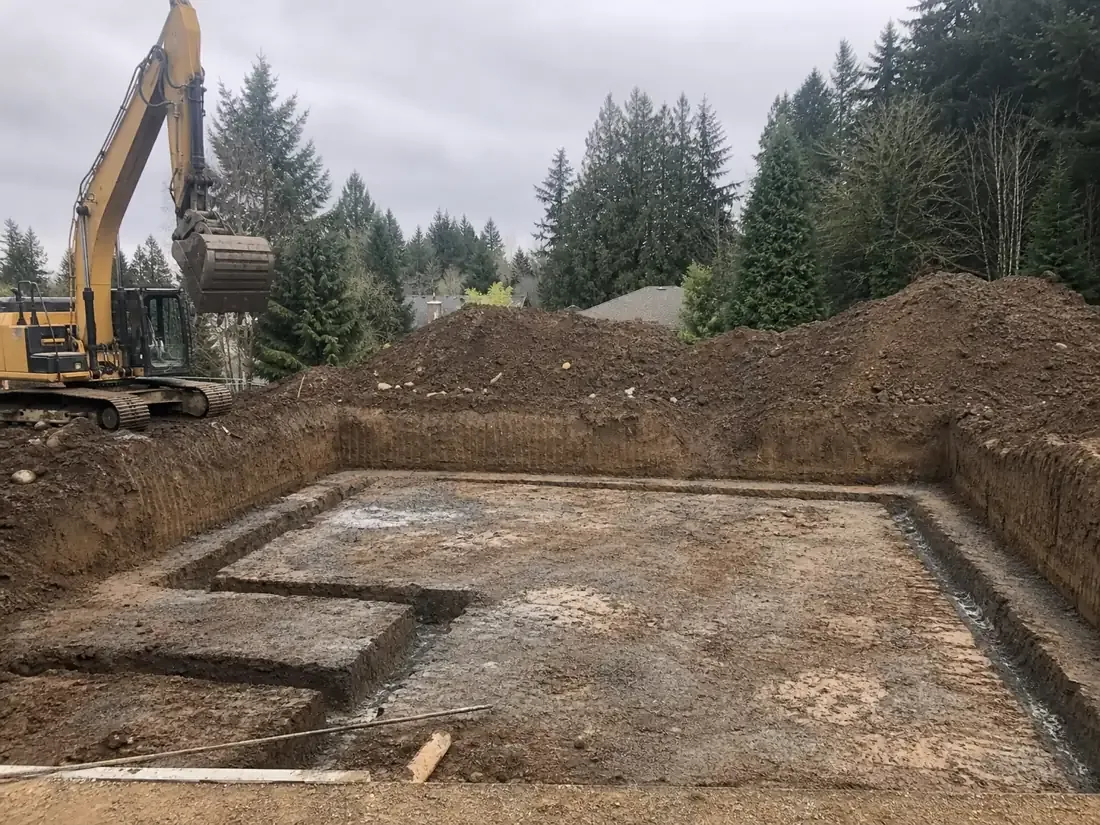
Foundation excavation cut into a hillside in Raleigh Hills Oregon showing shored cut face and interceptor drain above the dig
The uphill cut face is the critical stability element on a hillside foundation excavation; water intercepted above the dig does not have to be bailed out of it.

What Is Different About a Hillside Foundation Excavation

Each of the following items is either absent or minor on a flat-lot foundation dig. On a Raleigh Hills hillside site, all of them are active considerations from day one.

A contractor who quotes a hillside foundation excavation at the same per-cubic-yard rate as flat-ground work is not accounting for those factors. Excavation contractors in Beaverton, OR who specialize in sloped-site work price for the actual scope.

Water Management Is the First Priority, Not the Last

On a flat site, dewatering is a reactive measure — if groundwater enters the excavation, it is pumped out. On a hillside site in Raleigh Hills, reactive dewatering is the wrong approach. Water moving downhill through Tualatin Valley silty clay will enter an open excavation from the sides continuously during the wet season. The correct approach is to intercept that water above the excavation before it reaches the open cut — with a trench drain or perforated collector pipe along the upslope boundary of the dig, routed to a discharge point that does not direct water back toward the structure. That interception reduces the water entering the excavation to seepage rather than lateral flow, which is manageable. Failing to intercept it first means the bottom of the excavation becomes a collection sump that must be continuously pumped at high volume.

Backfill Against a Hillside Foundation

When the excavation is complete and the foundation walls are poured, backfilling against the uphill face introduces a new risk: the placed fill, if it is more permeable than the surrounding native soil, becomes the path water takes downhill alongside the structure. That water then concentrates at the base of the foundation wall and enters through any penetration or crack. The solution is drain rock and a waterproofing membrane on the uphill face of the foundation wall, with a perforated collector pipe at the footing directing water to a daylight outlet. Our Beaverton excavation crews coordinate that foundation drainage scope with the concrete contractor so it is completed before backfill goes in, not added as an afterthought once moisture problems appear.

Permits, Timing, and the Practical Reality of Hillside Access

Foundation excavation on a hillside in Washington County involves Washington County land use and building permits as a baseline, plus Oregon DEQ 1200-C stormwater permit requirements if the disturbed area reaches an acre. Clean Water Services erosion-control rules apply regardless of size and require an approved plan before ground is broken. On a steep Raleigh Hills lot, the disturbed area from the foundation excavation plus the access improvements plus the spoil staging can approach permit thresholds faster than a flat-lot project would. Identifying the permit requirements at the planning stage — before the excavation start date is set — prevents the project from stalling when a required submittal has not been filed.

Timing on a hillside foundation dig is more constrained than on a flat site. Starting the open excavation in late fall means working with a standing cut face through the full wet season while the foundation is formed and poured — a longer exposure period for the cut bank, more intensive dewatering if interception drainage is undersized, and slower equipment movement in wet conditions. The Beaverton excavation crew schedules hillside foundation digs to open in late spring where the project allows, giving the cut face maximum dry weather before the October rains and allowing the foundation to be poured and backfilled before the soil becomes saturated. Where the schedule is fixed, the drainage plan and shoring design are simply more conservative to compensate.

Excavation Services We Provide in Raleigh Hills

Raleigh Hills projects cutting a foundation into a hillside need excavation contractors in Beaverton, OR who plan for the cut face, the water, and the backfill drainage before they break ground.

Drainage & French Drains

Drainage & French Drains →

Site Preparation

Site Preparation →

Utility Trenching

Utility Trenching →

Grading & Leveling

Grading & Leveling →

Frequently Asked Questions

What makes a hillside foundation excavation different from a flat-lot dig?

On a slope, the uphill cut face may be many feet tall and must stay stable for the duration of construction, which can be months. Water moves laterally through the soil toward the open excavation rather than only from below. Spoil handling and equipment access are more complex on a grade. Backfill against the foundation must be designed to avoid becoming a water conduit alongside the structure. None of those factors are significant on a flat site.

Why is an interceptor drain needed above a hillside foundation excavation?

On a slope, groundwater moving downhill through Tualatin Valley silty clay enters an open excavation from the sides continuously during the wet season. Intercepting that flow with a trench drain or perforated collector pipe above the upslope edge of the dig redirects it around the excavation rather than into it. Without interception, the excavation bottom becomes a sump that requires continuous high-volume pumping to keep workable.

What is a stepped foundation and why is it common in Raleigh Hills?

A stepped foundation follows the grade across the building footprint rather than cutting to a single uniform depth. Each section of footing is at a different elevation, reducing the total cut volume on one end and the fill requirement on the other. Stepped foundations are common on hillside lots because they match the terrain more efficiently than a flat pad that would require either massive cut on the uphill side or extensive fill on the downhill side.

Do I need a permit for foundation excavation in Washington County?

A building permit from Washington County is required for any foundation construction. Oregon DEQ requires a 1200-C stormwater permit for projects disturbing an acre or more. Clean Water Services erosion-control rules apply to all ground disturbance in the service area regardless of size. On a hillside lot where excavation plus access improvements can approach permit thresholds faster than expected, identifying all requirements at the planning stage prevents mid-project stops.

What does hillside foundation excavation cost compared to a flat-lot dig?

A hillside foundation excavation costs more per cubic yard than a flat-lot dig because it involves shoring analysis for the cut face, an interceptor drainage system above the dig, more complex equipment access, staged spoil handling that keeps material away from the cut bank, and foundation drainage design before backfill. Those are real line items that take time and materials. A quote that matches flat-lot pricing for hillside work is not including them.

When is the best time to start a foundation excavation on a hillside in Raleigh Hills?

Late spring through early summer, where the schedule allows. Opening the excavation in dry weather means the cut face is exposed during the months of lowest groundwater flow and highest soil strength. The foundation can then be formed and poured before the October-to-May wet season returns. Projects that must begin in fall require a more conservative shoring and interception drainage design to manage the cut face through an extended wet-season exposure.
Get Your Free Beaverton Excavation Estimate

Send over the basics of the job and we will visit the property, walk the ground with you, and price the scope in writing — no pressure and no obligation. Call, text, or use the form; we reply the same business day.

We only use your info to contact you about your project. No spam, ever.

Prefer to talk?

Call or text to reach our team directly. During business hours we pick up when we can, and every message gets a return call.

(458) 272-9359

Hours: Mon–Sat, 7am–6pm