Serving Beaverton & all of Washington County, OR Free estimates: (458) 272-9359
Beaverton Excavation Co.

Home › Raleigh Hills

Site Preparation in Raleigh Hills, OR

Sloped lots in Raleigh Hills require cut-and-fill grading, benched fill placement, and compaction in lifts — not the same scope as a flat-lot job.

Licensed & insured in Oregon Free on-site estimates Local Washington County crew Wet-season ready

Raleigh Hills sits in the southwest hills of Washington County, where Oregon Routes 10 and 210 intersect and elevation change defines every lot. Cutting a level pad on that terrain is not the same operation as grading a flat valley-floor parcel — it requires moving real dirt volume from the high side and placing that cut material on the low side in a controlled, compacted fill. Beaverton Excavation Co. handles both sides of that equation on hillside sites throughout the area, from the initial survey stake to the finished subgrade ready for a slab or crawlspace.

The population of Raleigh Hills is roughly 6,196 people spread across a hillside community bordered by Beaverton to the west, West Slope to the north, and Progress and Garden Home to the south. That topography means almost no lot is naturally flat. When property owners decide to add a structure, an accessory dwelling, a shop, or even a substantial deck footing, the first question is always: how much material moves, and where does it go? The answer depends on slope angle, soil condition, and how the fill will be handled — and Tualatin Valley silty clay does not behave the same way imported gravel would.

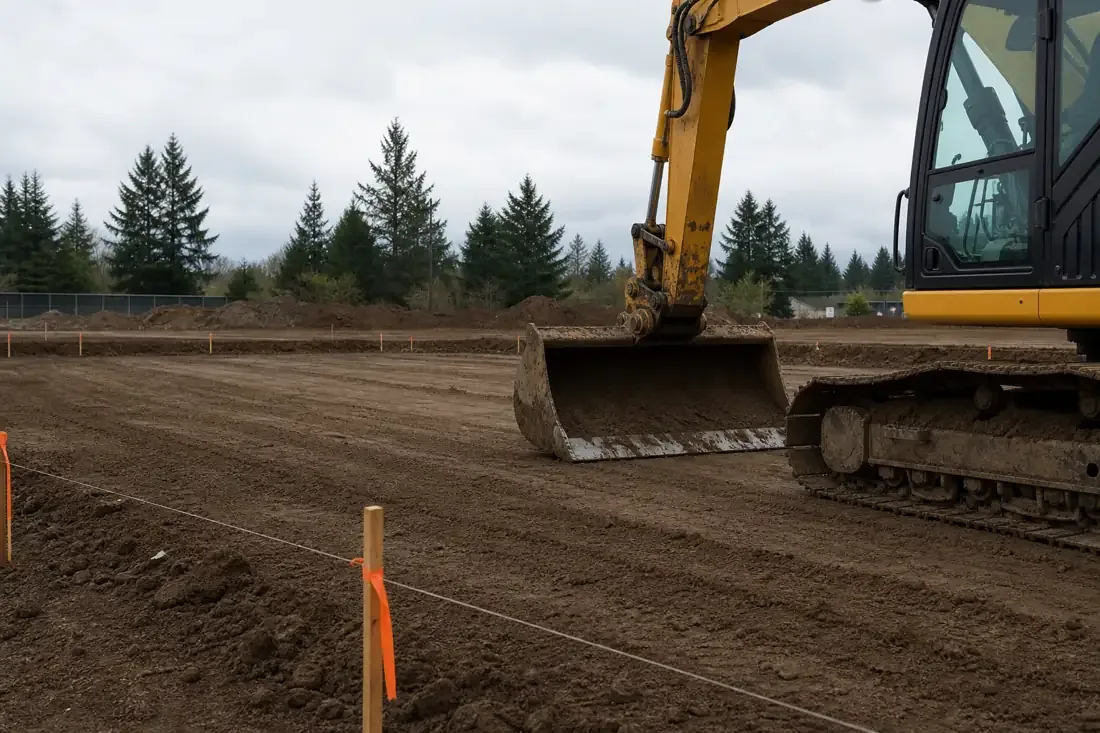
Excavator grading a sloped hillside lot for a level building pad in the Raleigh Hills area
Cutting the high side and benching fill into the slope produces a stable pad; simply dumping material on an unprepared face does not.

What Cut-and-Fill Site Preparation Actually Involves

On a hillside site, grading is a two-part operation: removing material from the high side (the cut) and placing that material on the low side (the fill). Each step has its own failure mode if it is done without the right technique.

Every one of those steps adds time and equipment compared with grading on level ground, which is why a hillside site-preparation quote from excavation contractors in Beaverton, OR will not match a flat-lot number from the same crew.

Why Fill Placed on an Unprepared Slope Face Fails

Tualatin Valley silty clay is cohesive when dry and nearly plastic when wet. During the October-through-May wet season, a hillside experiences sustained downward water movement through the soil. If fill material is simply pushed onto an unbenched slope face, two problems develop: first, the interface between the new fill and the original slope surface becomes a lubricated plane when saturated, and the fill block slides as a unit along it; second, the fill itself, if not compacted in lifts, consolidates unevenly as water works through it, producing surface settlement that tilts a slab, cracks a wall, or undermines a footing.

Retaining the Cut Face

When the high-side cut is deep enough, the exposed bank cannot simply be left as a slope. Washington County Clean Water Services erosion-control rules require that disturbed soil be stabilized, and a tall cut in silty clay is susceptible to sloughing even before the winter rains arrive. Depending on height, that stabilization may be a graded slope with erosion fabric and temporary seeding, a soldier-pile wall, or a block retaining wall built as part of the project scope. Our Beaverton excavation teams carry the equipment to do both the cut and the retention in a single mobilization, which reduces the number of times heavy equipment has to access a tight hillside site.

Cost, Timing, and Why Hillside Quotes Are Higher

A flat-lot pad preparation for a standard house in a valley-floor subdivision involves stripping topsoil, rough grading, and compacting the subgrade — relatively few machine hours and minimal hauling. A hillside pad in Raleigh Hills involves all of that plus the cut operation, benching, staged fill placement with compaction testing between lifts, cut-face treatment, and spoil hauling for any excess material that cannot be used on site. The machine time is longer, the site is tighter, and access from Oregon Routes 10 or 210 may require a traffic-control plan for equipment moves. Any quote that does not itemize those elements separately is either not accounting for them or assuming the owner will absorb the surprise cost when the work reveals it.

Timing matters on hillside work. Starting a major earthmoving project in November or December means working in active rainfall against Clean Water Services erosion-control requirements, and wet silty clay does not compact reliably. The Beaverton excavation crew typically recommends scheduling hillside grading for late spring through early fall when the soil is workable and compaction can be confirmed before winter loading begins. If a project must proceed in the wet season, the erosion-control plan and temporary drainage add to the scope and cost, and that should be estimated honestly before work starts rather than discovered mid-project.

Excavation Services We Provide in Raleigh Hills

Raleigh Hills homeowners and builders rely on excavation contractors in Beaverton, OR who understand hillside earthmoving before they schedule a site-preparation project.

Drainage & French Drains

Drainage & French Drains →

Site Preparation

Site Preparation →

Utility Trenching

Utility Trenching →

Grading & Leveling

Grading & Leveling →

Frequently Asked Questions

What does site preparation involve on a hillside lot in Raleigh Hills?

On a sloped lot, site prep means stripping organic topsoil, cutting material from the high side, benching steps into the existing slope face before placing fill, compacting that fill in lifts, stabilizing the cut bank, and finish-grading to drain away from the future structure. The volume of material moved and the spoil-hauling requirement are both larger than on a flat lot, which affects both project duration and cost.

Why does fill placed on a hillside slide if it is not benched?

When fill is placed against an unbenched slope, the interface between new material and the original ground becomes a potential sliding plane. Tualatin Valley silty clay is nearly frictionless when saturated. Benching cuts horizontal steps into the existing slope so the fill has a keyed ledge to bear against rather than an inclined surface to slide along. Without benching, the fill block can move as a unit during the wet season.

Do I need an erosion-control permit for grading work in Washington County?

Washington County operates under Clean Water Services erosion-control rules, which apply to any project that disturbs soil. For sites disturbing an acre or more, Oregon DEQ also requires a 1200-C stormwater permit before ground disturbance begins. Smaller projects still require an erosion-control plan and stabilization measures. The permit requirement should be identified and budgeted before excavation starts, not discovered mid-project.

Why is a hillside site-preparation quote higher than a flat-lot quote?

Flat-lot grading involves stripping, rough grading, and compacting a subgrade. Hillside work adds the cut operation, benching, staged fill placement with compaction testing between lifts, cut-face treatment, and spoil hauling for excess material. Machine time is longer, the site is tighter, and access on steep terrain is slower. Any quote that matches a flat-lot price for hillside work is not accounting for those additional operations.

What is the best time of year to do site preparation grading in Raleigh Hills?

Late spring through early fall. The October-through-May wet season brings sustained rainfall and saturated soil that does not compact reliably. Starting major earthmoving in dry months lets crews confirm compaction before the rains load the fill. Work in the wet season is possible but requires a more intensive erosion-control plan, temporary drainage, and careful scheduling around rainfall events, all of which add to the cost.

Where does the spoil go when more material is cut than can be used as fill?

Excess material is hauled off site to a licensed disposal or fill location. On a hillside lot, the cut volume often exceeds what can be placed as fill because the pad area is smaller than the bank that has to be removed to reach it. Spoil hauling — the number of truckloads and the haul distance — should be itemized in the estimate rather than treated as an allowance, because it is one of the larger line items on a hillside grading project.
Get Your Free Beaverton Excavation Estimate

Send over the basics of the job and we will visit the property, walk the ground with you, and price the scope in writing — no pressure and no obligation. Call, text, or use the form; we reply the same business day.

We only use your info to contact you about your project. No spam, ever.

Prefer to talk?

Call or text to reach our team directly. During business hours we pick up when we can, and every message gets a return call.

(458) 272-9359

Hours: Mon–Sat, 7am–6pm