Home › Raleigh Hills
A hillside gravel driveway needs cross-drains, water bars, and angular rock sizing to hold its surface through the October-to-May wet season.
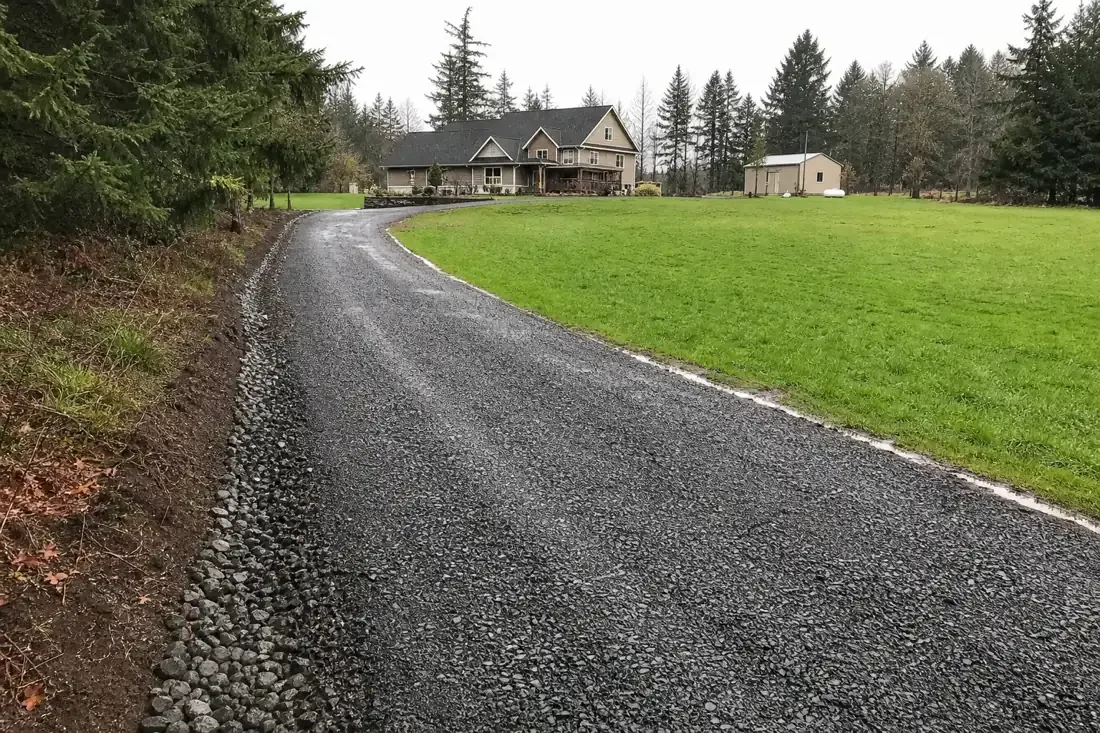
A gravel driveway on flat ground holds its surface from year to year with minimal maintenance. A gravel driveway on a slope does not — not without deliberate drainage design that takes water off the surface before it picks up the rock and carries it downhill. In Raleigh Hills, where the terrain slopes through the southwest hills of Washington County between Oregon Routes 10 and 210, almost every residential driveway has some grade to manage. Beaverton Excavation Co. builds sloped gravel driveways with the drainage features that make them last through the October-to-May wet season rather than washing out after the first heavy rain.
The wet season is not a minor factor. The Portland metro area receives most of its annual precipitation between October and May, and a hillside driveway that lacks cross-drainage becomes a channel during that period. Water follows the drive surface downhill, accelerating as it goes, and exits carrying fines and then coarser gravel until what remains is a rut-scarred track of large rock sitting on exposed subgrade. Restoring that surface costs more than building it correctly in the first place.
On any driveway with meaningful grade, the drainage design determines how long the surface holds. The following elements work together; leaving any one out reduces the effectiveness of the others.
Getting these elements right from the start is far less expensive than reapplying surface gravel each spring. Excavation contractors in Beaverton, OR who specialize in sloped-site work will specify each feature before breaking ground.
On a flat driveway, water that reaches the surface can be managed with simple cross-slope. On a Raleigh Hills grade, the water has kinetic energy — it is moving downhill continuously during a rain event, gaining speed with distance. That changes the interval at which cross-drains must be placed (shorter intervals on steeper grades), the rock size that will stay in place under traffic (larger on steeper grades), and the sizing of culverts at low points (undersized culverts back up and overtop, defeating the purpose). Tualatin Valley silty clay subgrade also becomes nearly incompressible when wet, so a vehicle turning or braking on a saturated sloped driveway exerts lateral force on the surface rock. Angular crushed rock with high interlock resists that force; rounded gravel or decomposed granite does not.
Where a Raleigh Hills driveway must include a turnaround pad or parking area, the grade at that location has to be brought within a range where vehicles can turn and park safely without rolling. A well-designed sloped driveway may include a leveled parking apron at the garage level, with the grade change handled in the approach run. That design element adds subgrade work but eliminates the problem of a vehicle rolling when left in gear on an inclined surface. Our Beaverton excavation crews grade the turnaround area as part of the driveway scope so the finished surface functions as a unit rather than as a series of independently sloped segments that drain against each other.
A sloped driveway costs more to build correctly than a flat one because it requires more drainage infrastructure per linear foot: more cross-drains, larger or more frequent culverts, uphill-edge ditching, and potentially a leveled parking area that requires its own subgrade work. The material cost is also higher because angular crushed rock in a larger sizing is specified rather than the cheapest gravel available. That upfront difference is the alternative to re-grading and re-graveling the surface every two or three years, which is the realistic maintenance cycle for a sloped driveway built without adequate drainage.
Maintenance intervals on a slope are genuinely shorter than on flat ground even when drainage is correct. Surface rock migrates downhill under repeated tire load, and the high-traffic areas near the road edge and the parking pad wear faster than the middle of the run. The Beaverton excavation crew recommends an inspection after each wet season to identify sections where gravel has thinned, cross-drains have silted, or culverts have partially blocked, and to add surface rock before the next season rather than after the damage has reached the subgrade. Scheduling that maintenance in late summer gives the replenished surface time to seat under dry conditions before the October rains begin.
Raleigh Hills property owners planning a new driveway or repairing an eroded one should speak with excavation contractors in Beaverton, OR who design drainage into the slope from the start.
During the October-to-May wet season, water flowing down the driveway surface picks up loose gravel fines first, then coarser rock as velocity increases. Without cross-drains and water bars to interrupt that flow at intervals, the entire length of the drive becomes a channel. Angular crushed rock with high interlock resists displacement better than rounded gravel, but no surface material survives unchecked channelized flow without ongoing replacement.
One-and-a-half-inch angular crushed rock is typically specified for sloped driveways. The angular faces interlock under tire load and resist downhill displacement better than round or smooth gravel. Smaller sizes travel farther downhill with each rain event, and decomposed granite breaks down into fines that muddy the surface under wet conditions. On steeper grades, a larger base layer of three-inch minus rock beneath the surface course provides additional stability.
The interval depends on slope angle and driveway length. On moderate grades, cross-drains every forty to sixty feet are common; steeper runs require shorter intervals to intercept water before it accelerates. A drain that is correctly placed but improperly sized will back up during a heavy event and overtop, so both spacing and pipe diameter need to be matched to the site. A site visit before design is the only way to specify the correct combination.
A new driveway connection to a public road typically requires a driveway approach permit from Washington County. Clean Water Services erosion-control rules apply if significant soil disturbance is involved. Culvert work on a property boundary or near a drainage feature may trigger additional review. Checking with the county before work begins is faster than stopping mid-project for a permit that was not anticipated.
A sloped driveway costs more per linear foot than a flat one because it requires additional drainage infrastructure: cross-drains, culverts, uphill-edge ditching, and potentially a leveled parking pad at the top or bottom. The surface rock specification is also more demanding. The cost difference is the alternative to re-graveling every two or three years, which is the realistic outcome for a sloped drive built without adequate drainage.
Late spring through early fall. Subgrade work and compaction are more effective in dry conditions, and the finished surface has time to seat under traffic before the wet season begins. Maintenance top-dressing is best scheduled in late summer after a site inspection identifies thin sections, silted cross-drains, or partially blocked culverts. Addressing those conditions before October means they do not become subgrade failures by December.
Send over the basics of the job and we will visit the property, walk the ground with you, and price the scope in writing — no pressure and no obligation. Call, text, or use the form; we reply the same business day.
Call or text to reach our team directly. During business hours we pick up when we can, and every message gets a return call.
(458) 272-9359Hours: Mon–Sat, 7am–6pm