Serving Beaverton & all of Washington County, OR Free estimates: (458) 272-9359
Beaverton Excavation Co.

Home › Aloha

Foundation Excavation in Aloha, OR

Flat ground and a high winter water table mean every foundation excavation in Aloha is a water-management job from the first day of digging.

Licensed & insured in Oregon Free on-site estimates Local Washington County crew Wet-season ready

Foundation excavation in Aloha, Oregon presents a challenge that hillside jobs rarely face: the ground is flat, and flat ground does not drain. When a crew from Beaverton Excavation Co. opens a foundation hole on a valley-floor lot, the excavation captures every drop of rain and groundwater that would otherwise sheet across the surface. On a sloped site, water moves away from the cut. On the Tualatin Valley floor where Aloha sits, there is nowhere for it to go. Without active water management from the first day of digging, that hole becomes a pond before the concrete crew ever arrives, eroding the walls and turning the floor into mud that cannot support a footing form.

Aloha is the flattest of the five communities served from this site, covering 7.36 square miles of nearly level valley-floor suburban land. The soil beneath it is Tualatin Valley silty clay, a material that holds water rather than transmitting it downward. The winter water table in this area rises sharply between October and May, sometimes reaching within a few feet of finish grade. A foundation excavation opened during that period can fill overnight. The clay walls of the hole absorb water, soften, and slough inward, undermining the adjacent soil and potentially damaging existing structures on tight suburban lots. Understanding this behavior before the machine moves is the starting point for any foundation plan in Aloha.

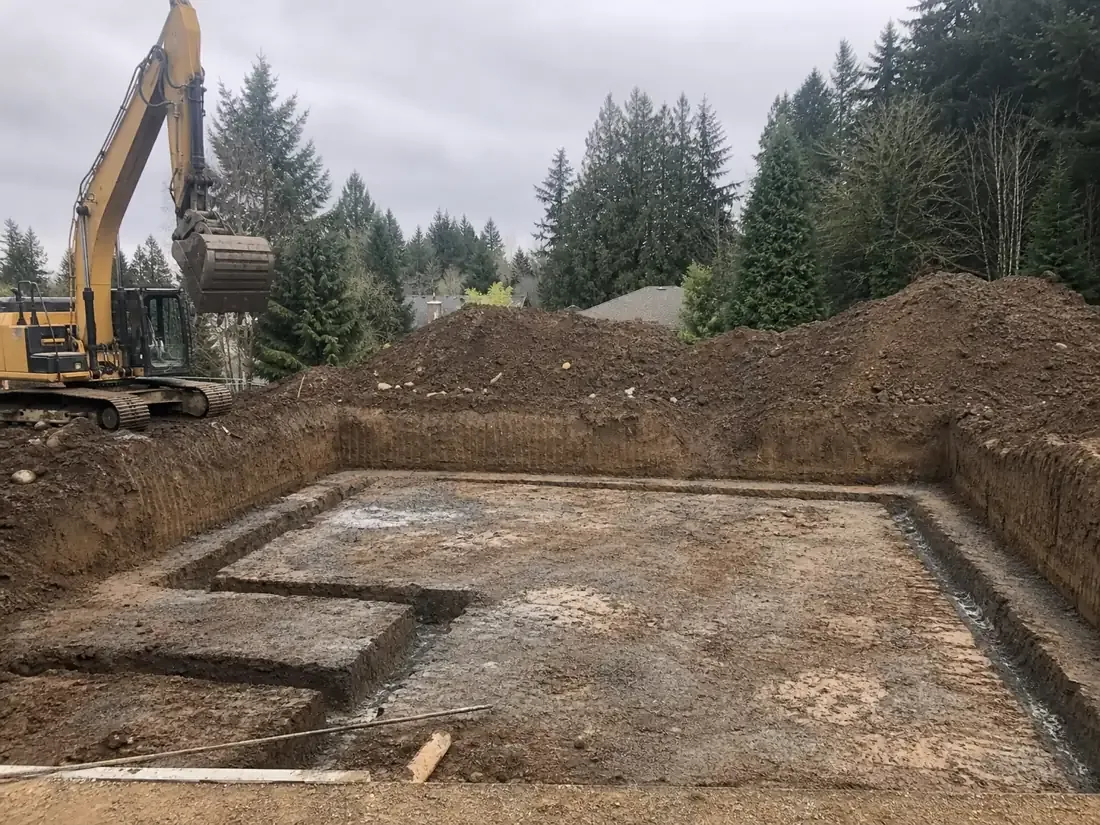
Excavated foundation hole on a flat suburban lot in Aloha, OR with submersible dewatering pump running
Active dewatering keeps a foundation excavation workable on Aloha’s flat clay lots, where a high winter water table fills an open hole faster than the concrete crew can work.

What a Foundation Excavation Job Covers on a Flat Aloha Lot

Foundation excavation on a level Aloha property is a managed sequence of steps, not simply digging to depth. Each step is designed to keep the hole open, the walls stable, and the surrounding yard functional while the concrete crew does its work over several days.

Each of these steps protects the foundation in a way that cannot be easily corrected later. Experienced excavation contractors in Beaverton, OR who have worked this specific valley-floor soil know the sequence and plan for it before the machine is ever delivered to the site.

Why Flat Ground Creates More Water Problems, Not Fewer

The common assumption is that a flat lot is simpler to excavate than a sloped one. On a hillside, at least gravity pulls water away from the cut face. On the valley floor where Aloha sits, there is no gradient to assist. Water that enters the excavation through the clay walls and floor has nowhere to go by itself. The silty clay underlying most of this area is nearly impermeable, so water cannot percolate downward into the ground at any useful rate. The water that collects in an open foundation hole in January or February can only be removed mechanically. This changes the equipment list, the crew schedule, and the overall cost structure of the job compared to the same work on a hillside site with well-drained soil. The flat terrain that makes Aloha straightforward for grading and utilities makes foundation excavation a different and more demanding water-management problem.

Keeping the Hole Stable During Concrete Work

Once excavation is complete and the hole is pumped dry, it must remain that way for several days while the concrete crew sets forms, pours footings, allows cure time, and sets foundation walls. Any interruption in dewatering during that window — a pump failure, a power outage, or a sustained rain event — can undo the drainage work and require re-excavation of sloughed material before concrete work can resume. The walls of an open clay excavation are not self-supporting indefinitely, especially when saturated soil is pushing laterally from behind. The approach used on every Beaverton excavation project in flat clay terrain accounts for this by coordinating the dewatering schedule directly with the concrete crew’s timeline rather than treating the two scopes as independent work orders that happen sequentially.

Permits, Timing, and Cost for Foundation Excavation in Aloha

Aloha is an unincorporated community within Washington County, so building permits flow through Washington County rather than a city building department. The excavation work itself does not require a separate excavation permit, but it must conform to the approved foundation plan included in the building permit package, and any erosion controls required by Clean Water Services apply from the first day the ground is disturbed. Oregon DEQ’s 1200-C stormwater permit applies to projects disturbing one acre or more; most residential foundation jobs fall below that threshold. Utility locates through 811 are legally required before digging begins, and on established Aloha lots that have been built out for decades, the density of buried utilities — water, sewer, gas, electrical, irrigation — can be significant. Missing a locate and cutting a line adds time and cost that no project budget accounts for.

Cost for a foundation excavation in Aloha is driven by three variables that the flat valley-floor soil magnifies relative to other sites: how much water must be pumped and for how long, how much spoil must be hauled off-site because there is no place to store it on a suburban lot, and what perimeter drain materials and labor cost when installed at excavation time versus retrofitted later. Getting an accurate number requires a site visit to assess the current water table depth, the lot constraints around the excavation, and the utility density. Rough estimates without a site visit routinely undercount the dewatering and hauling costs that flat clay terrain adds. The Beaverton excavation crew visits every site before pricing to make sure those variables are captured in what is quoted.

Excavation Services We Provide in Aloha

Aloha homeowners and builders rely on excavation contractors in Beaverton, OR who understand the valley-floor clay and seasonal water table that every foundation job here must plan around.

Drainage & French Drains

Drainage & French Drains →

Site Preparation

Site Preparation →

Utility Trenching

Utility Trenching →

Grading & Leveling

Grading & Leveling →

Frequently Asked Questions

Why does my foundation excavation fill with water on a flat Aloha lot?

Aloha sits on the Tualatin Valley floor, underlain by silty clay that holds rather than transmits water. The winter water table rises to within a few feet of the surface between October and May. A foundation hole on flat ground has no gradient to drain toward, so groundwater seeping through the clay walls and floor accumulates at the bottom. The only remedy is active dewatering — submersible pumps or well points that remove water continuously while the hole is open and concrete work proceeds. Passive drainage does not work on a flat clay site.

How long does the excavation have to stay open before the concrete work can start?

On a typical residential foundation in Aloha, the hole may stay open for several days while the concrete crew sets forms, pours footings, allows cure time, and then sets wall forms. Dewatering runs throughout that window. If the water table is very high at the time of the pour, the concrete crew may work in stages to limit how much of the hole is exposed at once. The schedule depends on foundation size and depth, water table elevation, and the specific concrete crew’s workflow. Coordinating these schedules before the job starts avoids costly delays mid-pour.

Can the excavated soil be stockpiled on my lot?

On most established Aloha suburban lots, there is limited room to stockpile spoil without covering buried utilities, blocking equipment access, or violating Clean Water Services erosion-control requirements. A full basement excavation generates a volume of clay that would occupy a substantial portion of a typical residential lot if piled on-site. The standard approach is to haul excavated material off-site in loads during the excavation. Hauling cost is factored into the job from the start rather than added later when the stockpile runs out of room.

Is a perimeter drain required around a new foundation in Aloha?

Washington County’s building code requires foundation drainage for basements and below-grade crawl spaces, and the high seasonal water table in Aloha makes perimeter drainage a functional necessity regardless of code requirements. The right time to install it is during the original excavation, when the outside of the foundation wall is fully exposed and accessible. Retrofitting a perimeter drain after backfill requires full re-excavation of the same perimeter at full depth, which costs substantially more than installing it the first time while the hole is still open.

What does foundation excavation cost in Aloha, OR?

Pricing for a residential foundation excavation in Aloha is driven by depth, footprint size, the water management requirements of the specific site, and spoil hauling distance. Flat valley-floor lots typically require more dewatering time than hillside sites with natural drainage, and most suburban Aloha lots require off-site hauling because there is no room to stockpile the excavated volume. A site visit is the only way to accurately price these variables. Estimates given without a site visit routinely miss the dewatering and hauling costs that flat clay terrain adds to every job.

When is the best time of year to excavate a foundation in Aloha?

Summer and early fall — roughly June through September — are the most favorable months for foundation excavation in Aloha. The water table drops during the dry season, reducing or eliminating the need for continuous dewatering, and the clay soil is drier and more stable as an excavation wall. Winter and spring excavations are possible and happen regularly, but they require active water management from the first day of digging and carry higher risk of delays if sustained rain events occur while the hole is open and the concrete crew is working.
Get Your Free Beaverton Excavation Estimate

Send over the basics of the job and we will visit the property, walk the ground with you, and price the scope in writing — no pressure and no obligation. Call, text, or use the form; we reply the same business day.

We only use your info to contact you about your project. No spam, ever.

Prefer to talk?

Call or text to reach our team directly. During business hours we pick up when we can, and every message gets a return call.

(458) 272-9359

Hours: Mon–Sat, 7am–6pm