Serving Beaverton & all of Washington County, OR Free estimates: (458) 272-9359
Beaverton Excavation Co.

Home › Aloha

Land Clearing in Aloha, OR

Aloha’s 18,547 established households produce clearing jobs defined by side-yard access and decades of accumulated growth — not raw acreage.

Licensed & insured in Oregon Free on-site estimates Local Washington County crew Wet-season ready

Land clearing in Aloha looks nothing like land clearing on a raw rural parcel. Aloha is 7.36 square miles of established suburban lots, all of them flat valley-floor ground, holding 18,547 households packed tightly together. The work Beaverton Excavation Co. handles here is overgrown back yards, fence lines choked with volunteer trees and decades of unchecked blackberry canes, and side lots that have accumulated brush since the neighborhood was built. The acreage numbers are small but the access and debris logistics are not simple.

Getting equipment to the work area is the first problem every Aloha clearing job presents. The property is occupied and surrounded by other occupied properties. Access is almost always a side yard or a gate, and the width of that gap — not the size of the work area — determines which machine can enter. If the gate is 36 inches, you work by hand and with compact equipment. If a fence panel comes down to let in a mini-excavator, that panel has to go back up the same day. Debris has to travel back through that same narrow channel and leave via a residential street, which means scheduling haul loads at times that do not block neighbors or violate Washington County residential access hours.

Land clearing in progress on an established suburban lot in Aloha, OR, with brush and overgrowth removed from a fenced back yard
Compact equipment and careful access planning are standard on Aloha’s residential lots, where the side-yard gate sets the machine size.

What Land Clearing Actually Involves on an Aloha Suburban Lot

Most Aloha clearing requests combine several types of work in a single back yard or side lot. The scope varies but the categories are consistent across the 53,828-person community’s established residential stock.

Aloha’s lot density and the age of its housing stock means almost every clearing job uncovers something unexpected: a buried concrete pad, an old fence post set in a footing, irrigation heads that predate any record. Coordinating with excavation contractors in Beaverton, OR who recognize these patterns before they become delays keeps residential clearing jobs on schedule.

Why Aloha’s Flat Ground Changes How Clearing Gets Done

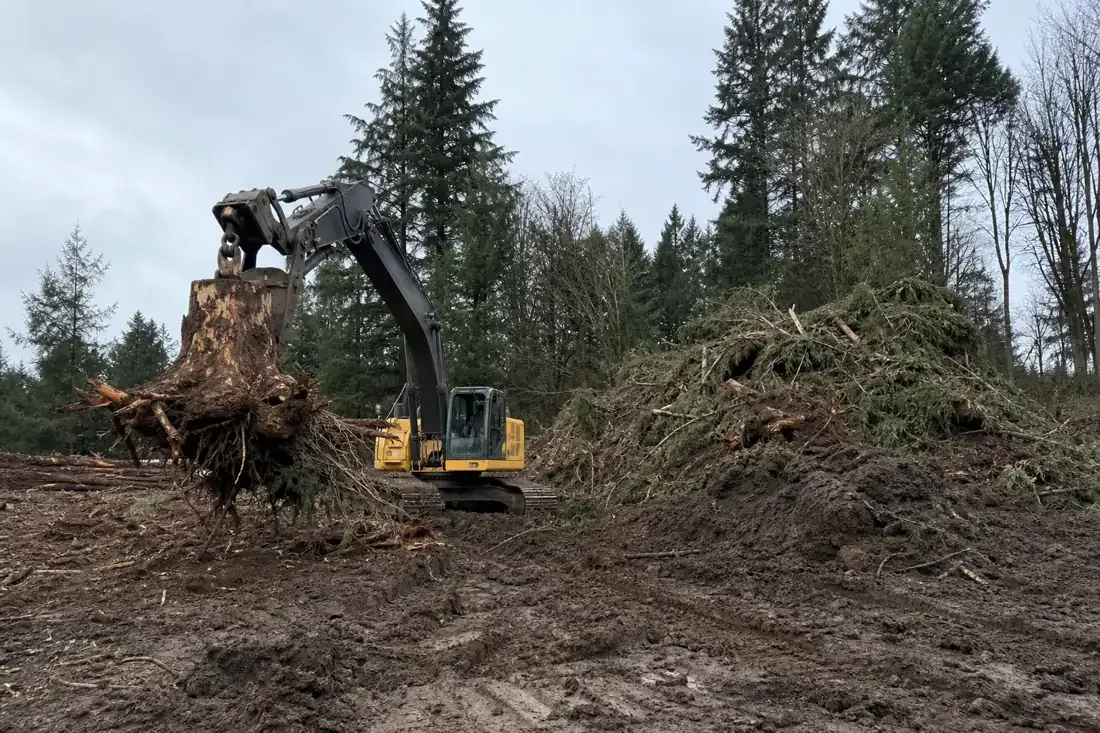
Most clearing advice assumes the land has some slope, which means water drains naturally and root extraction moves in a predictable direction. Aloha’s valley-floor position means the ground is nearly level across the whole community. When a root ball comes out on a sloped lot, the void drains on its own. When a root ball comes out on flat ground, that void holds standing water through the Oct-May wet season. Standing water in an open void softens the surrounding subgrade, which matters when the adjacent structure has a footing nearby. Tualatin Valley silty clay compounds this: it holds water instead of draining it, so saturation spreads laterally from any open void rather than moving down and away. Backfilling voids with suitable material and compacting in lifts is not optional on this ground — it is the step that prevents settled low spots and water infiltration problems months after the clearing crew has left.

Access Constraints and the Equipment Decision

The decision tree for equipment on an Aloha residential lot runs through access first and job size second. A half-acre clearing on a rural lot might use a full-size skid steer or excavator. That same half-acre spread across a densely occupied suburban neighborhood gets broken into segments, each segment limited by what can reach through a gate or over a fence without damaging it. Our Beaverton excavation crews carry a range of compact equipment specifically because Aloha’s lots demand it: a machine that can do the work means nothing if it cannot get to the work. Flagging underground lines with 811 before any mechanical work begins is required regardless of equipment size, but on lots this age — where private irrigation, outdoor lighting feeds, and workshop sub-panels are common — hand-tracing known private runs adds time that prevents far more expensive repairs.

Scheduling, Permits, and Cost on Aloha Clearing Jobs

Washington County does not require a grading permit for clearing work that stays below the threshold for disturbing one acre of land, and residential lot clearing in Aloha rarely approaches that scale. However, Clean Water Services erosion-control rules apply to any work that exposes bare soil within a regulated buffer, and the Oct-May wet season is the period when those rules are most actively enforced because exposed soil on flat ground has nowhere to go except into the drainage system. Jobs scheduled in that window require erosion controls — silt fencing, inlet protection, surface stabilization — that add cost to the project. Late spring and summer scheduling avoids that layer of complexity for straightforward residential clearing jobs, though the work can be done year-round with proper controls in place.

Cost on an Aloha clearing job is driven by access difficulty, root mass size relative to nearby foundations, debris volume, and the number of haul trips needed on a residential street. A back yard choked with blackberry but open through a wide gate costs less than the same area accessed through a 36-inch fence gap. Root extraction close to a foundation costs more than extraction in open ground because the approach is slower and more deliberate. The Beaverton excavation crew provides per-job estimates that separate access, material, hauling, and restoration line items so you understand what the largest cost drivers are before work begins rather than seeing a single number at the end.

Excavation Services We Provide in Aloha

Suburban lot clearing in Aloha calls for compact equipment, careful root extraction near structures, and haul logistics on residential streets — handled by excavation contractors in Beaverton, OR who know this ground.

Drainage & French Drains

Drainage & French Drains →

Site Preparation

Site Preparation →

Utility Trenching

Utility Trenching →

Grading & Leveling

Grading & Leveling →

Frequently Asked Questions

Can you clear a back yard that only has a narrow side-yard gate?

Yes. The gate width determines which equipment we bring, not the size of the work area. If a standard machine cannot fit through, we use compact equipment or hand tools for that segment. We will not remove a fence panel without your agreement, and any panel that comes down comes back up the same day. Access constraints affect the schedule and sometimes the cost but do not prevent the work.

Do you haul blackberry and brush or leave it for me to dispose of?

We haul everything. Organic brush, cut wood, and root masses all leave with the crew. Material is sorted at the site: clean wood goes one direction, invasive root masses another, because disposal differs by type. Haul trips on a residential street are scheduled to avoid blocking neighbors. Nothing is left on site unless you specifically ask for wood rounds to be kept for splitting.

How close to a foundation can you extract a root ball?

We hand-expose any root mass within several feet of a foundation before any machine applies tension. That means digging down to see where roots run relative to the footing, then cutting roots rather than pulling them blind. Ripping a mature root ball that runs under a footing can fracture the concrete. The hand-exposure step takes more time but prevents structural damage that would cost far more to repair.

Do you need to call 811 before clearing in a back yard?

Yes, always. 811 marks public utility lines, which run through back yards on easements. It does not mark private lines: irrigation feeds, outdoor lighting circuits, sub-panel runs to detached sheds or workshops. On Aloha’s established lots those private runs are common and rarely documented. We ask about known private lines before starting and hand-probe areas where they are likely before mechanical work begins.

What does residential lot clearing cost in Aloha?

Cost is determined by access difficulty, root mass size relative to nearby structures, debris volume, and haul trips on a residential street. A yard open through a wide gate with light brush costs less than the same square footage accessed through a narrow gap with multiple mature root balls near the fence line. We estimate each job separately and break out access, material, and hauling line items so you see where the cost is coming from before we start.

Can you work during the wet season, or should I wait until summer?

Clearing can be done year-round, but Oct-May wet-season jobs on Aloha’s flat ground require erosion controls anywhere bare soil is exposed near a drainage inlet or buffer. Clean Water Services rules apply to work in regulated areas, and the flat valley-floor grade means sediment has nowhere to move except into the drainage system. Summer scheduling avoids that layer for straightforward jobs; wet-season work is possible with the right controls in place, which adds to project cost.
Get Your Free Beaverton Excavation Estimate

Send over the basics of the job and we will visit the property, walk the ground with you, and price the scope in writing — no pressure and no obligation. Call, text, or use the form; we reply the same business day.

We only use your info to contact you about your project. No spam, ever.

Prefer to talk?

Call or text to reach our team directly. During business hours we pick up when we can, and every message gets a return call.

(458) 272-9359

Hours: Mon–Sat, 7am–6pm