Home › Aloha
Aloha’s flat valley-floor ground has no natural drainage fall — every pad, shop, and ADU slab needs drainage engineered in before the pour.
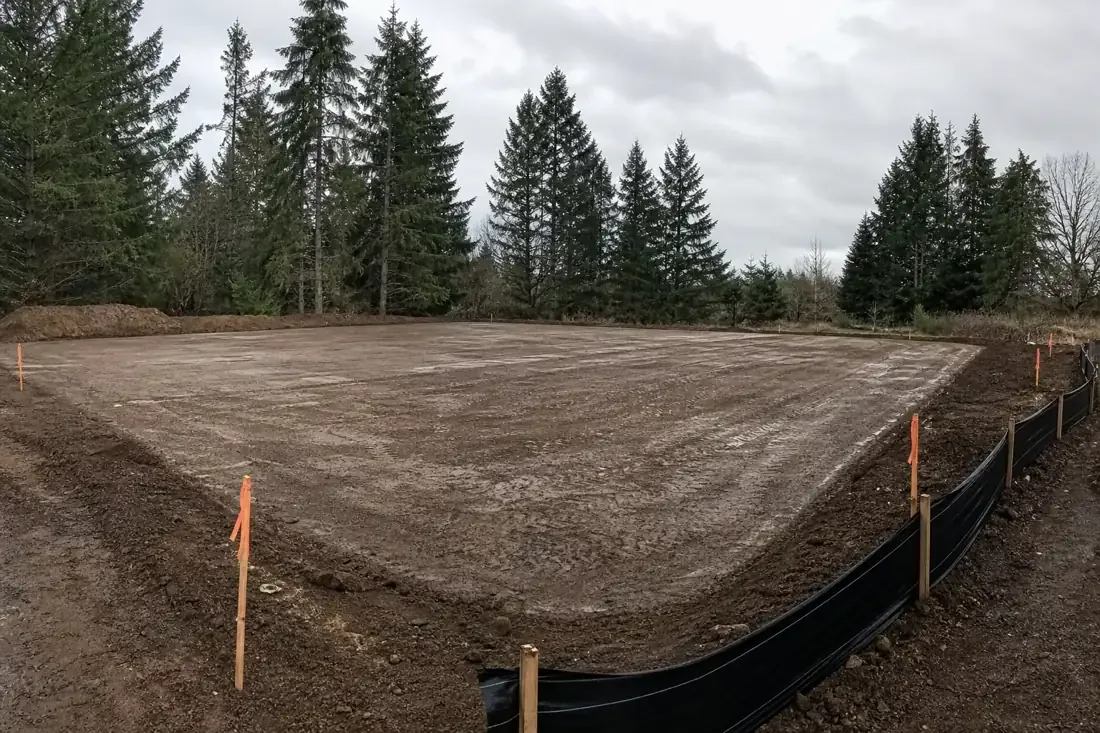
Site preparation in Aloha starts with a problem that does not exist on sloped ground: flat valley-floor land has no natural drainage fall. Aloha covers 7.36 square miles of nearly level terrain at the base of the Tualatin Valley, holding 18,547 households on established suburban lots. When a homeowner plans a slab, a shop, an ADU, or any concrete pad on that ground, the subgrade condition and drainage plan have to be engineered before the first yard of concrete is ordered. Beaverton Excavation Co. handles the preparation work that makes a flat-ground pour viable rather than a future problem.
The soil beneath Aloha’s surface is Tualatin Valley silty clay. Silty clay performs adequately as a subgrade when it is dry and compacted, but it loses bearing capacity quickly when it becomes saturated. The wet season in this region runs from October through May, which means the ground is actively absorbing water for seven months of the year. A slab poured on soft, saturated silty clay will crack as the ground cycles between wet and dry, expanding and contracting under the slab. Preventing that cycle starts below grade, not at the surface.
The sequence of work for a pad on Aloha’s valley-floor silty clay follows a specific order because each step creates the condition the next step depends on. Skipping or shortening any phase changes the long-term outcome of the pour.
Each of these steps can be done correctly or shortcuts can be taken — and the result of shortcuts on flat silty-clay ground almost always shows up within the first two or three wet seasons. Working with excavation contractors in Beaverton, OR who treat the preparation as the primary work rather than a preliminary to the pour produces slabs that do not require remediation.
On a sloped lot, surface water and subsurface water move in a predictable direction determined by grade. The contractor follows the slope, and drainage largely takes care of itself. On Aloha’s flat ground, there is no natural fall. Water that reaches the surface of a new pad has nowhere to go unless the pad was built with a deliberate cross-slope. Water that migrates under the pad from adjacent saturated ground cannot exit unless a perimeter drain intercepts it and routes it to an outlet. Silty clay transmits water slowly but holds it for a long time, so a wet-season saturation event can keep the subgrade soft well into summer. A slab sitting on periodically saturated subgrade will move as the clay swells and shrinks, and the cracks that result are not cosmetic — they compromise the structural integrity of the pour and the usefulness of the pad.
Concrete poured between October and May in the Tualatin Valley is poured onto or near saturated ground. The subgrade can be prepared correctly and still be exposed to winter moisture before the pour date, which is why the timing of the pour relative to wet-season conditions matters. A pad poured in July on a subgrade that was prepared in dry conditions and has not been re-wetted sits on stable ground from day one. The same pad poured in November has to account for the fact that the surrounding clay is at or near field capacity, lateral moisture migration is active, and the curing concrete is exposed to cold and wet conditions simultaneously. Our Beaverton excavation work on wet-season projects includes protective measures: keeping the prepared subgrade covered until pour day, scheduling the pour for a window without rain in the forecast, and confirming that the drainage outlets are functional before concrete goes down.
Washington County governs permitting for site work on unincorporated land, and Aloha is an unincorporated CDP, so Washington County rules apply rather than city codes. A residential slab or pad under a certain size typically falls under the building permit for the structure being built rather than requiring a separate grading permit. However, any site work that disturbs an acre or more requires an Oregon DEQ 1200-C stormwater permit and a stormwater pollution prevention plan. Most residential lots in Aloha are well under that threshold for a single-pad project. Clean Water Services reviews drainage on projects near regulated buffers, and their erosion-control requirements apply during construction regardless of project size. Connecting new drainage to the public system requires coordination with Washington County.
Cost for site preparation on a flat Aloha lot is driven primarily by how deep excavation must go to reach stable subgrade, how much structural fill is required to build back to grade, and how complex the drainage solution needs to be given the surrounding conditions. A lot where the native soil is firm and dry at modest depth costs less to prepare than a lot where organic material, prior uncompacted fill, or high winter water table requires deeper excavation and more imported fill. The Beaverton excavation crew provides a per-project estimate with excavation depth, fill quantity, drainage scope, and surface preparation as separate line items so you understand where the cost is concentrated before the first machine arrives.
Flat-ground site preparation on Aloha’s silty clay requires over-excavation, structural fill in lifts, and deliberate drainage design — work handled by excavation contractors in Beaverton, OR who understand valley-floor conditions.
Sloped ground drains by gravity. Flat Aloha valley-floor ground does not. Any pad, slab, or shop built on flat silty clay needs drainage engineered into it: a deliberate surface cross-slope to direct runoff, and subsurface drainage to intercept moisture that migrates laterally through the clay. Without those elements, water collects under and around the pad, the clay saturates and loses bearing capacity, and the slab moves and cracks as the ground cycles through wet and dry seasons.
It depends on what the native soil looks like at depth. On Aloha’s flat lots, silty clay can be stable below the first foot or it can be soft several feet down if there is buried organic material or a history of uncompacted fill. We probe and inspect the subgrade before committing to a depth. Over-excavation to reach a firm, consistent layer is the correct approach even if it adds cost, because filling over soft native soil transfers the problem below the fill rather than solving it.
Structural fill is clean, angular, well-graded material — typically crushed rock or road base — that compacts to a dense, stable mass when placed in lifts and rolled. Regular gravel or round rock does not interlock the same way and cannot achieve the same compaction density. Using the wrong material produces a fill layer that looks solid but deforms under load or allows water to migrate through it in ways that undermine the subgrade. Structural fill placed and compacted in specified lifts is what the engineering requires.
Aloha is unincorporated, so Washington County rules apply. Residential pad and slab projects typically fall under the building permit for the structure rather than requiring a separate grading permit, as long as land disturbance stays below one acre. Projects disturbing an acre or more require an Oregon DEQ 1200-C stormwater permit. Clean Water Services erosion-control requirements apply to any project that exposes bare soil near regulated buffers during the wet season, regardless of size.
The primary cost drivers are excavation depth to stable subgrade, the volume of structural fill needed to build back to grade, and the complexity of the drainage solution. A lot with firm native soil close to the surface and a straightforward drainage outlet costs less than a lot where soft or organic material requires deeper excavation and more imported fill, or where drainage must be routed around existing structures to reach a legal outlet. We price each job on its actual conditions rather than applying a flat square-footage rate.
Summer pours on prepared Aloha ground are simpler: the subgrade is dry, the curing conditions are favorable, and lateral moisture migration from surrounding clay is minimal. Oct-May pours require additional measures: protecting the prepared subgrade from re-wetting before the pour date, scheduling around rain windows, confirming drainage outlets are active, and sometimes adding insulation to protect curing concrete from cold. Winter pours are done regularly and successfully with the right preparation, but the steps cost more than a dry-season pour on the same footprint.
Send over the basics of the job and we will visit the property, walk the ground with you, and price the scope in writing — no pressure and no obligation. Call, text, or use the form; we reply the same business day.
Call or text to reach our team directly. During business hours we pick up when we can, and every message gets a return call.
(458) 272-9359Hours: Mon–Sat, 7am–6pm