Home › Aloha
Aloha’s established residential lots hold decades of unmarked private utilities — irrigation, lighting, and drainage runs that 811 cannot see and a machine bucket cannot avoid without hand-exposure first.
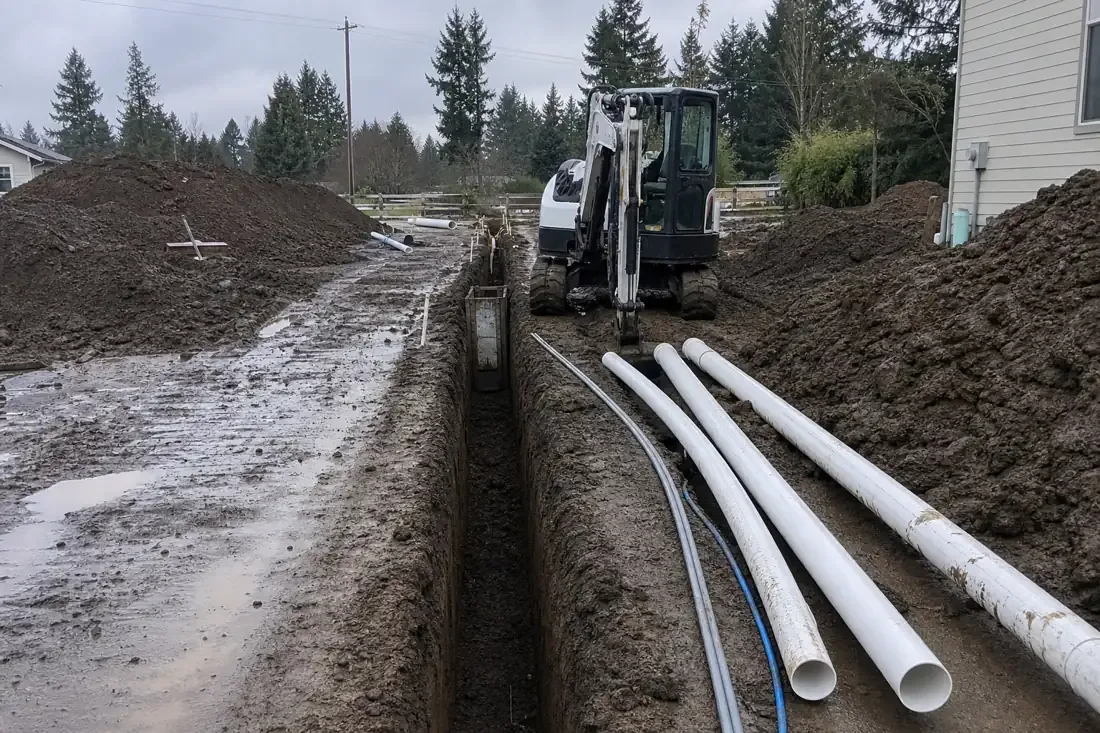
Utility trenching in Aloha means digging through occupied residential properties that have been built out, landscaped, and modified over decades. These are not vacant lots or new construction sites. The 53,828 people living across Aloha’s 7.36 square miles occupy homes with mature landscaping, established irrigation systems, concrete patios, fences, and outbuildings — all of which sit above or beside the path any new trench has to travel. Beaverton Excavation Co. approaches residential trenching as excavation through a finished environment, where the restoration at the end of the job is as important to the homeowner as the utility work itself.
The first and most important distinction on these properties is between public utilities and private utilities. Calling 811 before digging is required by law and locates gas, electric, telecom, water, and sewer lines in the public right-of-way and easements. It does not mark anything privately installed: the irrigation line a previous owner ran from the house to a shed, the outdoor lighting circuit buried under the lawn, the sub-panel feed to a workshop, the downspout drain connected to a drywell. On Aloha lots of this age those private runs are common, often undocumented, and exactly where a new trench is likely to cross them.
The physical work of digging a trench is straightforward. The complexity on Aloha’s residential lots comes from what exists in and around the trench path and what condition the surface must be in when the crew leaves.
On older Aloha properties where records of buried improvements are incomplete, the pre-excavation steps take more time than they would on a new subdivision lot. That time investment at the start is what keeps the job from turning into an emergency repair mid-dig. Teams that skip this step on the assumption that nothing unexpected is buried typically regret it on occupied Aloha lots. That is the experience excavation contractors in Beaverton, OR bring to this type of residential trenching work.
The age and density of Aloha’s residential stock creates a predictable private utility problem. A neighborhood developed over several decades accumulates improvements added by successive owners without any central record: irrigation systems installed in the 1980s and expanded in the 1990s, exterior lighting buried by one owner and extended by the next, downspout drains connected to dry wells in locations that made sense at the time but are not marked anywhere. The lots have 18,547 households across 7.36 square miles, and almost every one of them has been improved multiple times. None of those improvements show up when 811 runs the locate. The homeowner often does not know the full extent of what is buried because some of it predates their ownership. On flat ground with high winter water tables, buried drainage improvements are especially common because previous owners were trying to solve the same water management problem that the current owner is still dealing with.
Trench backfill on a sloped lot can be placed somewhat loosely and still drain because the natural grade moves water away from the trench zone. On Aloha’s flat ground, loose backfill becomes a linear water-collection point. The settled trench sits lower than the surrounding grade, water pools in it, and the silty clay around the trench slowly saturates from that pooling. Within one or two wet seasons, the linear settlement trench is visible as a swale running the length of the utility installation — directly above the new utility line. Correct backfill technique on flat ground places material in compactable lifts, mechanically densifies each lift before placing the next, and finishes with the backfill surface level with or very slightly above surrounding grade to account for the small residual settlement that occurs even with proper compaction. Our Beaverton excavation crews compact trench backfill as a standard step, not an upgrade, because the flat-ground consequence of skipping it is predictable and expensive to repair.
Utility trenching in Aloha is subject to Washington County rules for unincorporated land. Public utility connections require permits pulled by the licensed contractor doing the utility work — the plumber, electrician, or utility contractor — not by the excavation crew. The excavation itself for a residential private trench typically does not require a separate grading permit when it is incidental to permitted utility work. The 811 locate must be requested at least two full business days before digging, and marked utilities must be respected during excavation. Clean Water Services erosion-control requirements apply when trenching exposes soil near a regulated buffer or drainage feature, particularly in the Oct-May wet season when flat Aloha ground is already near saturation.
Cost for residential trenching in Aloha is driven by trench length and depth, the number of crossings that require hand-exposing, the difficulty of surface restoration, and whether any hardscape must be cut and repaired. A straight trench through an open lawn with no known private crossings costs less than the same length running past an irrigation system, under a patio section, and through an established planting bed that needs to be restored. The Beaverton excavation crew walks the trench path with the homeowner before pricing, identifies the crossings and restoration issues that will affect cost, and provides an estimate that accounts for the actual conditions on that specific lot rather than a per-linear-foot rate that ignores what the machine will encounter.
Trenching through Aloha’s occupied, mature residential properties requires private utility tracing, hand-exposed crossings, and full restoration — the specialty of excavation contractors in Beaverton, OR who work on established suburban lots.
No. 811 marks public utilities — gas, electric, telecom, water, and sewer — in the right-of-way and utility easements. It does not mark anything privately installed: irrigation lines, outdoor lighting circuits, sub-panel feeds to sheds or shops, or downspout drains connected to dry wells. On Aloha’s established lots those private runs are common and often undocumented. We interview the homeowner about known private utilities and hand-probe suspected paths before mechanical excavation reaches those areas.
We hand-excavate the crossing area with a shovel rather than advancing the machine bucket through it. A backhoe bucket cutting through a 1-inch poly irrigation line does so cleanly and leaves no surface evidence until the system runs; hand digging exposes the line so it can be relocated or protected before the trench continues. Once the crossing is confirmed safe, we flag it and proceed mechanically on either side. Any line that is damaged during the process is repaired before the trench is backfilled.
Established turf is the most common restoration challenge on Aloha residential lots. Where the trench runs through an established lawn, we cut sod carefully along the trench edges before excavating, store it during the dig, and relay it on compacted backfill after the utility is installed. Properly compacted backfill under relaid sod recovers significantly faster than seed on bare soil, and the finished surface shows much less evidence of the work. We establish the restoration plan before the first cut so you know what the outcome will look like.
Flat Aloha ground has no natural grade to move water away from a loose backfill zone. Uncompacted backfill settles over the first wet season and creates a linear depression directly over the trench line. Water pools in that depression, saturates the surrounding silty clay, and the settlement gets worse each wet season. Lift-by-lift compaction during backfilling prevents that settlement trench from forming. On sloped ground, poor compaction is a cosmetic problem. On flat ground, it becomes a drainage problem directly above the new utility.
Cost is driven by trench length and depth, the number of unmarked crossings that require hand-exposure, surface restoration complexity, and any hardscape that must be cut and repaired. A straight trench through open lawn with no known crossings prices very differently from the same length running through a planted bed, under a section of concrete patio, and past an irrigation manifold. We walk the trench path with you before quoting so the estimate reflects what is actually on your lot, not a standard linear-foot rate.
Oregon law requires the 811 locate request to be submitted at least two full business days before excavation begins. Locators mark public utilities within that window, but complex sites with multiple utilities may take the full two days. We coordinate the locate as part of scheduling and do not advance the machine until the marks are on the ground and the required wait period has passed. On residential lots with multiple utility types, confirming all marks are complete before starting avoids the delay of a missed locate holding up the job mid-dig.
Send over the basics of the job and we will visit the property, walk the ground with you, and price the scope in writing — no pressure and no obligation. Call, text, or use the form; we reply the same business day.
Call or text to reach our team directly. During business hours we pick up when we can, and every message gets a return call.
(458) 272-9359Hours: Mon–Sat, 7am–6pm